
12th Aug 2026
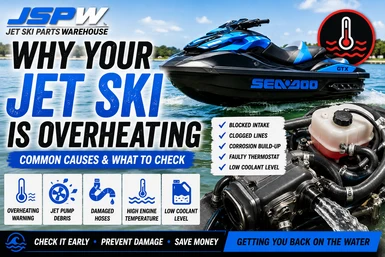
Why Your Jet Ski Is Overheating
An overheating warning on your jet ski isn't something to ignore.
Whether you ride a Sea-Doo, Yamaha or Kawasaki, excessive engine temperature can quickly turn a relatively minor cooling problem into an expensive engine repair.
The good news is that many overheating problems are caused by simple issues such as blocked cooling passages, damaged hoses or debris around the jet pump.
Here's what to check if your jet ski is running hot.
1. Blocked Cooling System
One of the most common causes of overheating is restricted water flow through the cooling system.
Sand, shells, salt deposits and other debris can restrict cooling passages and prevent enough water from circulating through the engine and exhaust.
This is particularly common on skis regularly operated in shallow or salt water.
Signs To Look For
-
Overheat warning
-
Reduced cooling-water flow
-
Excessive exhaust temperature
-
Overheating shortly after launching
If you suspect a blockage, stop riding and inspect the cooling system before continuing.
2. Debris In The Jet Pump Or Intake
Your jet pump does more than propel the ski. On many models, the pump also supplies water to the cooling system.
Debris around the intake or pump can interfere with water supply.
Check for:
-
Seaweed
-
Plastic
-
Fishing line
-
Rope
-
Sand
-
Stones and shells
Never reach into the intake or pump while the engine is running.
3. Blocked Cooling Lines
Cooling hoses can become restricted internally by salt, sand and corrosion.
Inspect the cooling lines for:
-
Blockages
-
Kinks
-
Cracks
-
Loose clamps
-
Collapsed hoses
A hose can look perfectly normal externally while being partially blocked internally.
4. Salt And Corrosion Build-Up
Saltwater riders need to pay particular attention to corrosion.
If a ski isn't flushed properly after use, salt deposits can gradually accumulate inside cooling passages.
Over time, this can restrict water flow and contribute to overheating.
This is why flushing your jet ski correctly after saltwater use is so important.
5. Damaged Or Disconnected Cooling Hose
A loose hose clamp or split cooling hose can significantly reduce cooling-water flow.
Inspect the engine bay for:
-
Water spraying while running
-
Loose hoses
-
Damaged clamps
-
Split fittings
-
Salt deposits around connections
Salt residue around a connection can be a useful clue that water has been leaking.
6. Thermostat Problems
Some jet ski engines use a thermostat to regulate operating temperature.
If the thermostat sticks closed or becomes restricted, coolant or cooling water may not circulate correctly.
Possible symptoms include:
-
Engine heats up unusually quickly
-
Overheating at particular RPM ranges
-
Temperature warning despite otherwise normal operation
A faulty thermostat should be replaced rather than ignored.
7. Closed-Loop Cooling Problems
Some Sea-Doo models use a closed-loop cooling system for the engine.
These systems contain coolant much like a car.
Check:
-
Coolant level
-
Coolant condition
-
Leaks
-
Expansion tank
-
Cooling hoses
However, remember that even on many closed-loop Sea-Doo systems, other components such as the exhaust still depend on raw water.
A healthy coolant level therefore doesn't automatically rule out a cooling problem.
8. Exhaust Cooling Problems
Your exhaust system also needs adequate cooling.
Restricted exhaust cooling can cause excessive temperatures even when the engine cooling system appears normal.
Potential causes include:
-
Blocked cooling passages
-
Damaged hoses
-
Corroded exhaust components
-
Restricted fittings
This is particularly important on older skis that have spent years operating in saltwater.
9. Faulty Temperature Sensor
Sometimes the engine isn't actually overheating.
A faulty temperature sensor, damaged wiring or corroded electrical connection may trigger an incorrect warning.
However, never assume the sensor is faulty until you've confirmed the cooling system is operating correctly.
Treat every overheating warning seriously.
10. Running The Engine Out Of Water For Too Long
Jet skis shouldn't be run dry for extended periods.
Although brief operation may be permitted for certain maintenance procedures, running the engine without the correct cooling-water supply can quickly cause excessive exhaust temperatures and damage components.
Always follow the manufacturer's procedure for your particular model.
What Should You Do If Your Jet Ski Overheats On The Water?
If an overheating warning appears while riding:
-
Reduce throttle immediately.
-
Stop the engine as soon as it's safe.
-
Check the intake grate for debris.
-
Inspect the jet pump area.
-
Look inside the engine bay for loose or leaking cooling hoses.
-
Allow the engine to cool.
Don't repeatedly restart the engine hoping the warning will disappear.
If the cause isn't obvious, get the cooling system inspected before riding again.
Can Overheating Damage A Jet Ski Engine?
Absolutely.
Continuing to operate an overheating engine can potentially cause:
-
Head gasket failure
-
Cylinder head damage
-
Piston damage
-
Exhaust system damage
-
Hose failure
-
Sensor damage
-
Complete engine failure
Stopping early can be the difference between replacing a hose and rebuilding an engine.
How To Prevent Your Jet Ski From Overheating
A few basic maintenance habits can dramatically reduce the risk:
-
Flush correctly after saltwater use.
-
Avoid accelerating hard in very shallow water.
-
Inspect the intake grate regularly.
-
Check cooling hoses and clamps.
-
Remove salt and corrosion build-up.
-
Maintain the jet pump.
-
Follow the manufacturer's service schedule.
-
Investigate temperature warnings immediately.
Need Jet Ski Cooling System Parts?
Jet Ski Parts Warehouse stocks a huge range of cooling and engine components for Sea-Doo, Yamaha and Kawasaki jet skis, including:
-
Cooling hoses
-
Hose clamps
-
Thermostats
-
Temperature sensors
-
Exhaust components
-
Jet pump parts
-
Gaskets and seals
-
Genuine OEM parts
-
Premium aftermarket replacements
-
Quality used OEM parts
If you're unsure which component suits your ski, contact the JSPW team with your make, model, year and OEM part number where available, and we'll help identify the correct replacement.
Final Thoughts
Overheating is one warning you should never ignore.
A blocked cooling line, piece of debris or leaking hose can start as a relatively simple problem but lead to major engine damage if you continue riding.
If your Sea-Doo, Yamaha or Kawasaki starts running hot, stop the ski, find the cause and repair the problem before heading back onto the water.
Catching the problem early is almost always cheaper than repairing the damage later.