
19th Aug 2026
Why Is My Sea-Doo Beeping? Common Warning Beeps Explained
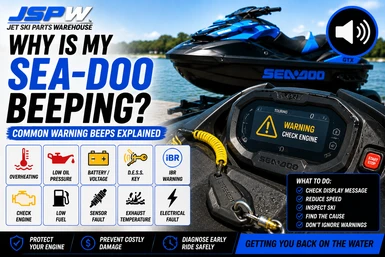
You're out enjoying your Sea-Doo when suddenly you hear a beep—or several—and a warning appears on the display.
A Sea-Doo's warning system is designed to alert you when the ECU detects something that needs your attention. Sometimes it's something relatively simple, while other warnings can indicate a problem that could damage the engine if you continue riding.
The important thing is not to ignore it.
Here's what your Sea-Doo may be trying to tell you and what you should check.
Why Does A Sea-Doo Beep?
Sea-Doo models use audible warnings together with the instrument display to alert the rider to operating conditions and detected faults.
Depending on the model and year, warnings may relate to:
-
Engine temperature
-
Oil pressure
-
Battery voltage
-
Exhaust temperature
-
Fuel level
-
iBR system
-
Engine management system
-
D.E.S.S. key recognition
-
Sensors or electrical faults
The exact beep pattern and warning system varies between models and years, so always check the owner's or workshop manual for your particular Sea-Doo.
1. Engine Overheating
An overheating condition is one of the most important warnings to take seriously.
Possible causes include:
-
Blocked cooling passage
-
Debris around the jet pump
-
Restricted cooling hose
-
Damaged hose
-
Low coolant on applicable models
-
Thermostat problem
-
Cooling system leak
If an engine temperature warning appears, reduce throttle and stop the engine as soon as it's safe.
Continuing to operate an overheating engine can cause serious damage.
2. Exhaust Overheating
Even Sea-Doo models with closed-loop engine cooling still use raw water for parts of the exhaust cooling system.
A blockage can therefore cause an exhaust temperature warning even when the engine coolant level is normal.
Possible causes include:
-
Blocked water supply
-
Sand or debris
-
Restricted cooling hose
-
Damaged exhaust cooling component
Don't assume a closed-loop Sea-Doo can't suffer from a cooling-water problem.
3. Low Oil Pressure
An oil-pressure warning needs immediate attention.
Possible causes include:
-
Low engine oil level
-
Incorrect oil level
-
Oil pump problem
-
Blocked oil passage
-
Faulty pressure sensor
-
Internal engine problem
If you receive an oil-pressure warning while riding, shut the engine down as soon as it's safe and check the cause before continuing.
Running an engine without adequate oil pressure can cause major internal damage very quickly.
4. Battery Or Charging-System Warning
A beep accompanied by a battery or voltage warning can indicate that system voltage is outside the expected range.
Possible causes include:
-
Weak battery
-
Loose battery terminals
-
Corroded terminals
-
Charging-system fault
-
Regulator/rectifier problem
-
Damaged wiring
-
Poor earth connection
A battery can sometimes have enough power to start the ski while still having a charging-system problem.
Check battery voltage and connections before automatically replacing the battery.
5. D.E.S.S. Key Or Safety Lanyard Problem
Many Sea-Doo models use the Digitally Encoded Security System (D.E.S.S.).
If the ski doesn't correctly recognise the key or lanyard, you may receive a warning.
Possible causes include:
-
Incorrect key
-
Damaged key
-
Dirty connection
-
Faulty D.E.S.S. post
-
Wiring problem
-
Key programming issue
Depending on the model, the display may also provide a message helping identify the problem.
6. Check Engine Warning
A check-engine warning means the ECU has detected a fault.
This can involve numerous systems, including:
-
Sensors
-
Fuel injection
-
Ignition system
-
Throttle system
-
Supercharger-related systems
-
Electrical wiring
-
Engine-management components
The warning alone doesn't necessarily identify the failed component.
Retrieving the stored fault code is often the next step.
7. iBR Warning
Sea-Doo's Intelligent Brake and Reverse system controls braking and reverse operation on equipped models.
An iBR warning can be caused by:
-
iBR actuator problem
-
Obstruction around the reverse gate
-
Damaged linkage
-
Sensor fault
-
Electrical problem
-
Low battery voltage
If an iBR fault occurs, reverse or braking functionality may be limited.
Inspect the rear of the ski for obvious debris or damage before further diagnosis.
8. Low Fuel Warning
Not every beep means something has failed.
Your Sea-Doo may simply be warning you that the fuel level is low.
Don't ignore this one either—jet skis can consume fuel surprisingly quickly when ridden hard.
Always plan your ride with enough fuel to return safely.
9. Sensor Failure
Modern Sea-Doos use numerous sensors to monitor the engine and other systems.
These may include sensors for:
-
Temperature
-
Pressure
-
Throttle position
-
Crankshaft position
-
Intake pressure
-
Exhaust conditions
A faulty sensor or damaged connection can trigger warnings even when the mechanical system itself appears normal.
10. Corroded Electrical Connections
Jet skis operate in one of the harshest environments possible for electrical equipment.
Salt, water and moisture can cause:
-
Corroded terminals
-
Poor earth connections
-
Damaged plugs
-
Intermittent sensor signals
-
Voltage problems
If warnings appear intermittently, inspect electrical connectors carefully.
Pay Attention To The Display
Don't diagnose a Sea-Doo solely from the number of beeps.
Modern Sea-Doo displays may provide additional information such as:
-
CHECK ENGINE
-
HIGH EXHAUST TEMPERATURE
-
LOW OIL
-
LOW VOLTAGE
-
iBR warning
-
Engine temperature warning
-
Fault code
Write down or photograph the message before switching everything off.
That information can make diagnosis much easier later.
What Should You Do When Your Sea-Doo Starts Beeping?
If you hear an unexpected warning:
-
Look at the instrument display.
-
Note any warning message or fault code.
-
Reduce speed.
-
Check for obvious overheating.
-
Check the engine compartment for leaks.
-
Inspect the jet pump and intake for debris.
-
Check battery voltage if an electrical warning is present.
-
Stop the engine if the warning indicates a serious condition.
If you're unsure what the warning means, don't continue riding hard until the cause has been identified.
How Do I Find The Sea-Doo Fault Code?
Depending on the model and year, stored fault information may be available through the instrument display or require diagnostic equipment.
Sea-Doo dealers and appropriately equipped workshops can use BRP diagnostic systems to access stored faults and live engine information.
A fault code can dramatically narrow down the problem.
However, remember:
A fault code identifies the system where a problem has been detected—it doesn't always mean the component named in the code needs replacing.
Wiring, connectors and related components should also be checked.
Can I Keep Riding If My Sea-Doo Is Beeping?
That depends entirely on the warning.
A low-fuel alert is very different from an oil-pressure or overheating warning.
You should stop riding if you receive a serious warning relating to:
-
Overheating
-
Oil pressure
-
Critical engine fault
-
Major electrical problem
-
Any condition where the engine sounds or behaves abnormally
Continuing to ride can turn a relatively minor problem into an expensive repair.
Don't Just Disconnect The Battery To Clear The Warning
Clearing or temporarily removing a warning doesn't repair the fault that caused it.
If the warning returns, diagnose the underlying problem.
Stored fault information can also be valuable when troubleshooting, so avoid repeatedly clearing faults before recording them.
Need Sea-Doo Replacement Parts?
Jet Ski Parts Warehouse stocks a huge range of Sea-Doo electrical, cooling and engine components, including:
-
Temperature sensors
-
Pressure sensors
-
D.E.S.S. components
-
Batteries
-
Voltage regulators
-
Starter motors
-
Starter solenoids
-
Cooling hoses
-
Thermostats
-
iBR components
-
ECU and electrical components
-
Genuine OEM parts
-
Premium aftermarket parts
-
Quality used OEM components
If you've received a warning or fault code and aren't sure which part you need, contact JSPW with your Sea-Doo model, year and fault code or warning message, and we can help identify the correct parts.
Final Thoughts
If your Sea-Doo starts beeping, don't panic—but don't ignore it either.
Start with the information on the display and work from there.
Some warnings are simple reminders, while others are designed to protect the engine from serious damage. Identifying the warning early, checking the obvious causes and retrieving fault codes where necessary can save considerable time and money.
When in doubt, stop the ski and diagnose the problem before heading back out.
It's much cheaper than replacing an engine.