
2nd Sep 2026
What Causes A Jet Ski To Blow Smoke? White, Blue & Black Smoke Explained
Seeing smoke coming from your jet ski can be alarming—especially if it suddenly appears when the ski normally runs clean.
But smoke doesn't always mean your engine is about to fail.
The colour of the smoke, when it appears and how the engine is running can provide useful clues about what's happening.
A two-stroke jet ski may produce some visible exhaust smoke during normal operation, while persistent smoke from a modern four-stroke Sea-Doo, Yamaha or Kawasaki deserves closer investigation.
Here's what the different smoke colours can mean and what you should check.
First: Is It Actually Smoke?
Before diagnosing an engine problem, make sure you're actually seeing smoke.
Jet ski exhaust systems contain water, so under certain conditions you may see steam or water vapour coming from the exhaust.
This can be more noticeable:
-
During cold starts
-
In cool weather
-
While flushing
-
When the exhaust system is warming up
Steam normally disappears relatively quickly once it reaches the air.
Thick smoke that persists, smells strongly of fuel or burnt oil, or is accompanied by poor engine performance deserves further investigation.
1. Blue Smoke – The Engine May Be Burning Oil
Blue or blue-grey exhaust smoke generally indicates oil is being burned during combustion.
How concerning this is depends heavily on the type of engine.
Two-Stroke Jet Skis
Some smoke is normal on a two-stroke because oil is intentionally mixed with the fuel or supplied through an oil-injection system.
You may notice additional smoke:
-
During cold starting
-
After extended idling
-
After storage
-
When excessive oil has accumulated
However, dramatically more smoke than normal can indicate a problem.
Possible causes include:
-
Incorrect fuel/oil mixture
-
Oil-injection problem
-
Excessive oil supply
-
Carburettor problems
-
Engine wear
Know what's normal for your particular ski.
2. Blue Smoke On A Four-Stroke Jet Ski
Persistent blue smoke from a four-stroke Sea-Doo, Yamaha or Kawasaki is more concerning.
Four-stroke engine oil shouldn't normally enter the combustion chamber in significant quantities.
Possible causes include:
-
Worn piston rings
-
Cylinder wear
-
Valve stem seal problems
-
Excessive engine oil
-
Oil entering the intake system
-
Internal engine damage
If the engine is also consuming oil, losing compression or running poorly, further diagnosis is recommended.
3. Too Much Engine Oil
Overfilling a four-stroke jet ski engine can create problems.
Excessive oil may be pushed into the intake system and eventually burned by the engine.
Symptoms may include:
-
Blue smoke
-
Oil inside the air intake
-
Oil consumption
-
Poor running
Jet ski oil-level checking procedures can be very specific.
Don't assume the oil should simply be filled to the highest point on the dipstick while the engine is cold.
Follow the manufacturer's procedure for your exact model.
4. Worn Piston Rings
Piston rings help seal the combustion chamber and control oil on four-stroke engines.
As they wear, oil can enter the combustion chamber and burn.
Possible symptoms include:
-
Blue smoke
-
Increased oil consumption
-
Reduced compression
-
Loss of power
-
Excessive crankcase pressure
A compression test can help identify a cylinder with a potential sealing problem.
A leak-down test may provide further information about where compression is being lost.
5. Valve Stem Seal Problems
Four-stroke engines use seals around the valve stems to control oil.
Worn or damaged valve stem seals can allow oil into the combustion chamber.
One possible symptom is a puff of blue smoke when starting the engine after it has been sitting.
Further engine inspection may be required to confirm the cause.
6. White Smoke Or Steam
White exhaust can have several causes.
First determine whether it's:
Steam/water vapour
or
actual smoke.
Because PWCs use water-cooled exhaust systems, some visible vapour can be normal.
Persistent thick white exhaust combined with other symptoms needs investigation.
7. Water Entering The Engine
Water ingestion is a much more serious possibility.
Water can enter a jet ski engine through several routes depending on the model and circumstances.
Warning signs may include:
-
Engine suddenly stopped while riding
-
Difficult or impossible cranking
-
Water inside the intake
-
Milky engine oil on four-strokes
-
Abnormal exhaust
-
Misfiring after a rollover or flooding incident
If you suspect water has entered the engine, don't repeatedly crank or run it hoping the water will disappear.
Water ingestion can cause severe internal damage.
8. Coolant Entering The Engine
Some jet skis use closed-loop engine cooling systems containing coolant.
If coolant enters the combustion chamber because of an internal failure, it may produce persistent white exhaust.
Potential causes can include:
-
Head gasket failure
-
Cylinder-head problem
-
Internal cooling-system leak
Other symptoms may include:
-
Coolant loss
-
Overheating
-
Rough running
-
Compression problems
If coolant level continues dropping without an obvious external leak, investigate further.
9. Black Smoke – Too Much Fuel
Black or dark exhaust generally points toward an excessively rich fuel mixture.
The engine is receiving more fuel than it can burn efficiently.
Possible causes include:
-
Faulty fuel injector
-
Fuel pressure problem
-
Sensor fault
-
Restricted air intake
-
Engine-management problem
-
Carburettor problem on older models
You may also notice:
-
Strong fuel smell
-
Poor fuel economy
-
Rough running
-
Fouled spark plugs
-
Hesitation
-
Reduced performance
10. Fouled Spark Plugs
Spark plugs can provide useful clues when diagnosing a smoking engine.
Remove and compare them.
Dry Black Plug
May indicate excessive fuel or carbon fouling.
Wet With Fuel
May indicate that cylinder isn't burning fuel correctly.
Oily Plug
May indicate oil entering the combustion chamber.
One Plug Different From The Others
This can help narrow the problem down to a particular cylinder.
Don't just replace a badly fouled plug without considering why it became fouled.
11. Faulty Fuel Injector
A leaking or malfunctioning injector can supply excessive fuel to one cylinder.
Possible symptoms include:
-
Black smoke
-
Rough idle
-
Strong fuel smell
-
Difficult starting
-
Poor fuel economy
-
Fouled spark plug
Injector testing may be required to confirm the problem.
12. Restricted Air Intake
An engine needs the correct balance of air and fuel.
If airflow is restricted, the engine may run excessively rich.
Check for:
-
Blocked air intake
-
Damaged intake components
-
Foreign objects
-
Oil contamination
-
Collapsed hoses
Supercharged models should also have their intake and boost system inspected if performance has changed.
13. Smoke After Long-Term Storage
A jet ski that has been sitting for months may smoke more than usual when first started.
Possible causes include:
-
Residual oil
-
Fogging oil used during storage
-
Stale fuel
-
Fouled spark plugs
Some temporary smoke may clear as the engine reaches operating temperature.
If it continues, investigate rather than assuming it's simply because the ski was stored.
14. Smoke After An Engine Rebuild
A freshly rebuilt engine may produce some temporary exhaust smoke depending on the engine and assembly procedure.
However, persistent heavy smoke shouldn't simply be dismissed as "running in."
Check:
-
Oil level
-
Compression
-
Spark plugs
-
Fuel mixture
-
Engine performance
If something doesn't seem right after a rebuild, investigate it early.
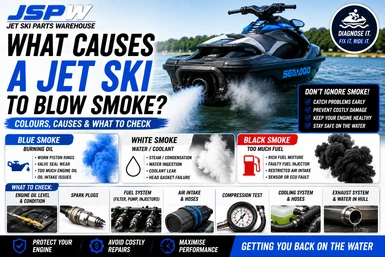
Smoke Colour Quick Guide
| Smoke/Exhaust Colour | Possible Causes |
|---|---|
| Blue / Blue-Grey | Burning oil, excessive oil, worn rings, valve seals |
| White | Steam/water vapour, water ingestion, coolant-related problem |
| Black / Dark | Excessive fuel, injector problem, restricted intake |
| Normal two-stroke haze | Oil being burned as part of normal two-stroke operation |
Smoke colour is a diagnostic clue—not a guaranteed diagnosis.
What Should You Check First?
If your jet ski suddenly begins smoking:
Step 1 – Stop And Observe
Note:
-
Smoke colour
-
When it occurs
-
Whether it clears
-
Engine temperature
-
Engine performance
Step 2 – Check The Oil
On four-strokes, verify the oil level using the correct manufacturer's procedure.
Look for:
-
Overfilling
-
Low oil
-
Fuel smell
-
Milky contamination
Step 3 – Inspect The Spark Plugs
Compare all cylinders.
Step 4 – Check Fuel And Air Systems
Look for obvious fuel or intake problems.
Step 5 – Check Compression
If you suspect internal engine wear, perform a compression test according to the procedure for your particular engine.
When Should You Stop Riding?
Stop the engine and investigate if the smoke is accompanied by:
-
Overheating
-
Oil-pressure warning
-
Severe loss of power
-
Knocking or mechanical noise
-
Water-contaminated oil
-
Rapid coolant loss
-
Significant oil consumption
-
Heavy continuous smoke
Continuing to ride can turn a relatively manageable repair into a complete engine failure.
Need Jet Ski Engine Parts?
Jet Ski Parts Warehouse stocks a huge range of engine, fuel and ignition components for Sea-Doo, Yamaha and Kawasaki jet skis, including:
-
Pistons
-
Piston rings
-
Cylinder sleeves
-
Valves
-
Valve stem seals
-
Head gaskets
-
Top-end gasket kits
-
Spark plugs
-
Ignition coils
-
Fuel injectors
-
Fuel pumps
-
Engine rebuild kits
-
Genuine OEM parts
-
Premium aftermarket parts
-
Quality used OEM components
If you're trying to diagnose a smoking jet ski, contact JSPW with your make, model, year and symptoms, and we'll help identify the parts you may need.
Final Thoughts
Smoke coming from a jet ski doesn't automatically mean the engine is finished.
Start with the colour.
Blue smoke usually points toward oil being burned.
Black smoke generally suggests excessive fuel.
White exhaust may simply be steam, but persistent white smoke combined with other symptoms needs further investigation.
And remember that visible smoke from an older two-stroke can be completely normal.
The important thing is recognising when the amount or colour of smoke has changed.
If your ski suddenly starts smoking heavily, loses power, overheats or develops an unusual engine noise, stop riding and diagnose the cause before further damage occurs.
Catching the problem early could mean the difference between replacing a relatively inexpensive component and rebuilding an entire engine.