
16th Sep 2026
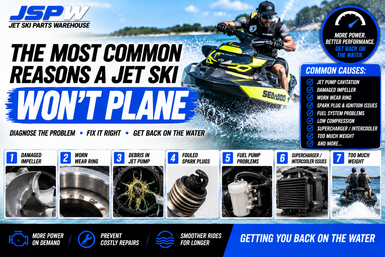
The Most Common Reasons A Jet Ski Won't Plane
You squeeze the throttle, the engine revs up—but instead of climbing onto the plane and accelerating normally, your jet ski struggles through the water.
A jet ski that won't plane can feel sluggish, rev excessively or simply refuse to build speed.
The problem usually falls into one of two categories:
The engine isn't producing enough power, or the jet pump isn't converting that power into enough thrust.
Whether you ride a Sea-Doo, Yamaha or Kawasaki, here are the most common causes and what you should check.
What Does "Getting On The Plane" Mean?
At low speed, much of the hull sits in the water.
As speed increases, hydrodynamic lift raises more of the hull out of the water. This reduces drag and allows the ski to accelerate efficiently.
This is known as planing.
If something prevents the ski from producing sufficient power or thrust, it may struggle to reach this point.
1. Jet Pump Cavitation
Cavitation should be one of the first things you consider.
A typical symptom is:
Engine RPM rises quickly, but the ski doesn't accelerate accordingly.
It can feel similar to a slipping clutch in a car.
Possible causes include:
-
Damaged impeller
-
Excessive pump clearance
-
Damaged wear components
-
Debris in the pump
-
Air entering the pump
-
Pump damage
If the engine sounds strong but the ski barely moves, inspect the jet pump first.
2. Damaged Impeller
The impeller is responsible for accelerating water through the jet pump to create thrust.
Even relatively small damage can reduce its efficiency.
Look for:
-
Chipped blades
-
Bent blades
-
Gouges
-
Corrosion
-
Cracks
-
Damaged blade edges
Impeller damage commonly occurs after sucking up:
-
Rocks
-
Shells
-
Gravel
-
Sand
-
Rope
-
Debris
If the problem began immediately after riding in shallow water, inspect the impeller.
3. Worn Wear Ring Or Pump Housing
The clearance around the impeller is critical.
If the clearance becomes excessive, water can escape around the impeller rather than being efficiently forced through the nozzle.
This can cause:
-
Cavitation
-
Poor hole-shot
-
High RPM with low speed
-
Difficulty getting onto the plane
-
Reduced top speed
Sea-Doo commonly uses replaceable wear-ring arrangements on many models, while Yamaha and Kawasaki pump designs differ depending on the model.
Inspect the complete pump rather than assuming every ski uses the same wear components.
4. Debris Inside The Jet Pump
It doesn't take much debris to dramatically affect pump performance.
Common offenders include:
-
Rope
-
Fishing line
-
Seaweed
-
Plastic bags
-
Timber
-
Stones
Always switch the engine off and remove the safety lanyard before inspecting the intake or jet pump.
Never put your hands near the pump with the engine running.
5. Damaged Intake Grate
Water needs to enter the jet pump cleanly.
A bent, damaged or obstructed intake grate can disturb water flow.
Inspect for:
-
Impact damage
-
Broken sections
-
Loose hardware
-
Debris
-
Heavy marine growth
A problem before the impeller can affect everything happening after it.
6. Incorrect Impeller
If the problem started after replacing or upgrading the impeller, check that the correct impeller has been installed.
Impellers differ in:
-
Diameter
-
Pitch
-
Blade design
-
Engine application
-
Performance characteristics
An incorrectly matched impeller can significantly affect acceleration and engine RPM.
Performance impellers should be selected for the exact engine and intended use.
7. Jet Pump Bearing Problems
Worn pump bearings can increase resistance and cause additional pump problems.
Warning signs include:
-
Grinding
-
Rumbling
-
Whining
-
Excessive vibration
-
Shaft play
If the pump sounds abnormal, don't continue riding until you've inspected it.
A failed bearing can damage considerably more than the bearing itself.
8. Engine Isn't Producing Full Power
If the pump appears healthy, look at the engine.
A jet ski needs substantial power to climb onto the plane.
An engine running on fewer cylinders or unable to reach its intended output may move the ski slowly but struggle under load.
Possible causes include:
-
Fouled spark plugs
-
Ignition coil failure
-
Fuel delivery problem
-
Low compression
-
Sensor fault
-
Restricted intake
-
Supercharger problem
9. Fouled Spark Plugs
Spark plugs are one of the easiest things to check.
A fouled plug can cause one cylinder to misfire.
The ski may:
-
Start normally
-
Idle reasonably well
-
Move at low speed
…but struggle badly when you apply full throttle.
Remove and compare the plugs.
If one looks dramatically different from the others, investigate that cylinder further.
10. Faulty Ignition Coil
A weak or failed ignition coil can create similar symptoms.
Watch for:
-
Misfire
-
Rough running
-
Hesitation
-
Loss of power
-
Poor acceleration
-
Check-engine warning
On engines using identical individual coils, swapping coils between cylinders can sometimes help identify whether the fault follows the coil.
11. Fuel Pump Problems
A weak fuel pump may supply enough fuel for idle and low-speed operation but struggle when the engine demands more fuel.
Possible symptoms include:
-
Hesitation
-
Surging
-
Loss of power
-
Engine won't reach full RPM
-
Poor acceleration
Fuel-pressure testing can help determine whether the system is maintaining the correct pressure under load.
12. Blocked Fuel Filter
Before condemning the fuel pump, inspect the filter where applicable.
A restricted filter can reduce fuel flow and produce similar symptoms.
If the filter is overdue for replacement, include it in your diagnosis.
13. Fuel Injector Problems
A dirty or failing injector can prevent one cylinder from producing full power.
Possible symptoms include:
-
Rough running
-
Misfire
-
Poor acceleration
-
Difficult starting
-
Uneven spark-plug appearance
Don't assume every misfire is ignition related.
14. Low Engine Compression
An engine with low compression may still start and run but struggle badly under load.
Low compression can be caused by:
-
Worn piston rings
-
Damaged piston
-
Cylinder wear
-
Valve problems on four-strokes
-
Head gasket problems
A compression test can quickly identify a cylinder that's significantly different from the others.
15. Supercharger Problems
If you own a supercharged Sea-Doo, Yamaha or Kawasaki, a boost problem can cause a major reduction in power.
Possible causes include:
-
Supercharger fault
-
Boost leak
-
Loose hose
-
Damaged intake connection
-
Intercooler problem
The engine may still run smoothly—it simply won't produce the power you're expecting.
If a supercharged ski suddenly becomes dramatically slower without obvious misfiring, inspect the boost system.
16. Intercooler Problems
Supercharged models use an intercooler to reduce intake-air temperature.
A damaged, restricted or leaking intercooler can affect engine performance.
Possible symptoms include:
-
Loss of acceleration
-
Reduced top speed
-
Poor boost performance
-
Engine feels flat under load
Saltwater-operated skis deserve particularly careful intercooler inspection.
17. Restricted Air Intake
An engine needs sufficient airflow to make power.
Inspect the intake system for:
-
Blockages
-
Damaged hoses
-
Collapsed hoses
-
Water
-
Oil contamination
-
Loose connections
If the engine can't breathe properly, performance will suffer.
18. Engine In Limp Mode
Modern jet skis can limit engine power when the ECU detects certain faults.
You may notice:
-
Reduced RPM
-
Limited speed
-
Warning message
-
Check-engine light
-
Beeping
Check the display for warning messages and retrieve stored fault codes where possible.
Don't replace performance components until you've ruled out an electronically limited operating mode.
19. Overheating
An overheating condition may trigger reduced engine performance or a warning mode.
Check:
-
Cooling-water flow
-
Cooling hoses
-
Jet pump intake
-
Thermostat
-
Coolant level where applicable
-
Exhaust cooling system
Never continue riding hard with an overheating warning.
20. Too Much Weight
Sometimes nothing is actually broken.
Passengers, fuel and equipment all add weight.
A ski may struggle to plane if it's:
-
Overloaded
-
Carrying too many passengers
-
Loaded heavily at the rear
-
Operating beyond its rated capacity
Check the manufacturer's maximum load specification.
If the ski performs normally with one rider but struggles heavily loaded, weight distribution and capacity deserve consideration.
21. Water Inside The Hull
A hull containing a significant amount of water becomes considerably heavier.
If your ski suddenly feels sluggish, inspect the engine compartment.
Look for:
-
Drain-plug leaks
-
Driveshaft seal leaks
-
Sea-Doo carbon-ring problems where applicable
-
Cooling-hose leaks
-
Exhaust leaks
-
Hull damage
A ski filling with water is a safety issue—not simply a performance problem.
22. Hull Damage Or Heavy Marine Growth
The underside of the hull has a major effect on drag.
Inspect for:
-
Significant hull damage
-
Distortion
-
Marine growth
-
Heavy fouling
A badly fouled hull requires considerably more power to move through the water.
The Most Important Diagnostic Question
When a jet ski won't plane, ask:
Does The Engine Rev High?
YES — High RPM, Poor Acceleration
Look first at:
-
Cavitation
-
Impeller
-
Wear ring/pump housing
-
Pump clearance
-
Debris
-
Intake grate
The engine is making RPM, but the pump isn't effectively converting it into thrust.
NO — Engine Won't Reach Normal RPM
Look first at:
-
Spark plugs
-
Ignition coils
-
Fuel system
-
Compression
-
Supercharger
-
Intercooler
-
Sensors
-
Limp mode
The engine itself may not be producing enough power.
This distinction can save a lot of unnecessary diagnosis.
Quick Troubleshooting Guide
Revs Hard But Barely Accelerates
Check the jet pump.
Runs Rough And Won't Plane
Check ignition and fuel delivery.
Runs Smooth But Has Very Little Power
Check boost system on supercharged models and inspect for limp mode.
Suddenly Stopped Planing After Shallow-Water Riding
Inspect the impeller, intake and pump.
Performance Poor With Several Passengers
Check load capacity and weight distribution.
Ski Feels Unusually Heavy
Check the hull for water.
Don't Keep Riding A Cavitating Jet Ski
Cavitation isn't simply annoying.
Continued operation can contribute to further wear and damage.
If the engine is revving aggressively but the ski isn't accelerating, reduce throttle and investigate the cause.
Need Parts To Restore Your Jet Ski's Performance?
Jet Ski Parts Warehouse stocks a huge range of propulsion, engine and fuel-system components for Sea-Doo, Yamaha and Kawasaki jet skis, including:
-
Impellers
-
Wear rings
-
Jet pump housings
-
Jet pump rebuild kits
-
Bearings and seals
-
Driveshafts
-
Intake grates
-
Spark plugs
-
Ignition coils
-
Fuel pumps
-
Fuel filters
-
Fuel injectors
-
Supercharger components
-
Intercoolers
-
Pistons and engine rebuild components
-
Genuine OEM parts
-
Premium aftermarket parts
-
Quality used OEM components
If you're unsure what's causing your ski to struggle onto the plane, contact JSPW with your make, model, year and symptoms, and we'll help point you towards the components worth checking.
Final Thoughts
If your jet ski won't plane, don't start replacing parts randomly.
First determine whether the engine is producing RPM.
High RPM + poor acceleration usually points towards the jet pump or cavitation.
Low RPM + poor acceleration usually points towards an engine, fuel, ignition or electronic problem.
That simple distinction can dramatically narrow down the diagnosis.
Check the pump, impeller and intake first when the engine is revving normally. If the engine itself isn't producing full power, move on to spark, fuel, compression and boost systems.
Find the cause early, repair it correctly and you'll get your Sea-Doo, Yamaha or Kawasaki back onto the plane—and back on the water.