
19th Aug 2026
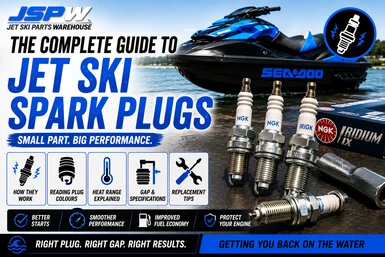
The Complete Guide To Jet Ski Spark Plugs
Spark plugs might be small, but they play a huge role in how well your jet ski starts, idles and performs.
A worn, fouled or incorrect spark plug can cause everything from difficult starting and rough running to misfires, reduced power and increased fuel consumption. In many cases, replacing the plugs is also one of the cheapest and easiest maintenance jobs you can perform.
Whether you ride a Sea-Doo, Yamaha or Kawasaki, here's what you need to know about choosing, inspecting and replacing your jet ski spark plugs.
What Do Spark Plugs Actually Do?
Each spark plug creates the electrical spark that ignites the air/fuel mixture inside the combustion chamber.
This happens thousands of times every minute while the engine is running.
For the engine to perform correctly, the spark plug needs to:
-
Produce a strong, consistent spark
-
Operate at the correct temperature
-
Have the correct electrode gap
-
Seal properly against the cylinder head
-
Resist fouling and corrosion
Even a small problem with one plug can noticeably affect engine performance.
Signs Your Jet Ski Spark Plugs Need Replacing
Spark plug problems can produce several symptoms.
Watch for:
-
Hard starting
-
Extended cranking
-
Rough idle
-
Engine misfires
-
Hesitation during acceleration
-
Reduced top speed
-
Poor throttle response
-
Increased fuel consumption
-
Engine starts but won't run properly
-
One cylinder not firing correctly
Fouled plugs in particular can cause irregular running, misfiring, reduced performance and increased fuel consumption.
Why Do Jet Ski Spark Plugs Foul?
Jet skis operate in conditions that can be particularly demanding on spark plugs.
Common causes of fouling include:
Excessive Idling
Long periods of low-speed operation can prevent the plugs from reaching their ideal operating temperature.
Rich Fuel Mixture
Too much fuel can leave black carbon deposits on the plug.
Oil Fouling
This is particularly relevant to two-stroke engines, where excessive oil or other engine problems can leave oily deposits on the plug.
Repeated Short Runs
Starting the ski repeatedly without allowing the engine to reach proper operating temperature can contribute to fouling.
Engine Problems
Repeatedly fouling the same plug can indicate a deeper problem.
Don't keep replacing plugs without investigating why they're failing.
How To Read A Jet Ski Spark Plug
Removing your plugs can tell you a surprising amount about what's happening inside the engine.
Light Brown / Tan
Generally indicates normal combustion.
Dry Black Deposits
May indicate excessive fuel, prolonged low-speed running or carbon fouling.
Wet With Fuel
The cylinder may be receiving fuel but failing to ignite it correctly.
Possible causes include ignition problems or repeated unsuccessful starting attempts.
Oily Black Deposits
May indicate excessive oil or another combustion-related issue.
Very White Or Overheated
This deserves further investigation.
An overheated plug can indicate excessive combustion temperature or an incorrect plug specification. Kawasaki's service information, for example, warns that incorrect heat-range plugs can cause engine damage.
Choosing The Correct Spark Plug
This is important:
Don't simply install a plug because it physically screws into the cylinder head.
Spark plugs differ in:
-
Thread diameter
-
Thread reach
-
Heat range
-
Electrode design
-
Resistance
-
Terminal design
-
Plug gap
The wrong plug can cause poor performance and, in some situations, engine damage.
Always select the plug specified for your exact make, model, year and engine.
What Does Spark Plug Heat Range Mean?
Heat range describes how effectively a spark plug transfers heat away from its firing end.
A hotter plug retains more heat.
A colder plug transfers heat away more quickly.
It doesn't mean one produces a hotter or stronger spark.
Using a plug that's too cold can contribute to fouling, while an incorrect heat range in the other direction can expose the engine to excessive temperatures.
Unless the engine has been modified and you know exactly what you're changing, stick with the manufacturer's specified heat range.
Standard vs Iridium Spark Plugs
You'll often see both conventional and iridium spark plugs available.
Standard Spark Plugs
Advantages include:
-
Lower cost
-
Proven performance
-
Widely available
-
Excellent for routine servicing
Many jet skis were designed to use conventional NGK plugs from the factory.
Iridium Spark Plugs
Iridium plugs use a fine-wire precious-metal centre electrode.
Depending on the application, they can offer:
-
Longer service life
-
Excellent ignition performance
-
Improved resistance to electrode wear
But an iridium plug isn't automatically an upgrade for every jet ski.
Use the plug type recommended for your engine or a properly verified alternative.
Does Spark Plug Gap Matter?
Absolutely.
The gap is the distance between the centre electrode and ground electrode.
If the gap is incorrect, you may experience:
-
Misfires
-
Loss of power
-
Fouling
-
Poor fuel economy
-
Accelerated plug wear
NGK specifically recommends checking the required gap against the engine manufacturer's specification rather than assuming a new plug is correctly gapped for your particular engine.
Different jet skis use different specifications. For example, published PWC application charts show substantially different gaps across Sea-Doo, Yamaha and Kawasaki models.
Never assume there's one universal jet ski spark plug gap.
Be Careful Gapping Iridium And Fine-Wire Plugs
Fine-wire plugs require extra care.
If adjustment is permitted for your particular plug, don't lever against the fine centre electrode or ceramic insulator.
NGK advises adjusting only the ground electrode because pressure against the fine centre electrode can damage the plug.
Some manufacturers also specify that certain plugs should not be adjusted at all. For example, Kawasaki documentation for some models instructs owners to replace the plug if its gap is outside specification rather than adjusting it.
Check the manual for your exact ski.
How To Replace Jet Ski Spark Plugs
Replacing spark plugs is generally straightforward.
Step 1: Allow The Engine To Cool
Never remove spark plugs from a hot aluminium cylinder head.
Let the engine cool before starting.
Step 2: Remove The Ignition Coils Or Plug Leads
Depending on the engine, you'll have either ignition coils mounted directly over the plugs or conventional plug leads.
Remove them carefully.
Don't pull aggressively on the wiring.
Step 3: Clean Around The Spark Plug
Before removing the plug, make sure dirt, sand and debris aren't sitting around the plug hole.
You don't want contamination falling into the cylinder.
Step 4: Remove The Old Plug
Use the correct spark plug socket and carefully loosen the plug.
Once removed, inspect it before throwing it away.
The condition of the old plug may provide useful information about how the engine is running.
Step 5: Check The New Plug
Confirm:
-
Correct part number
-
Correct heat range
-
Correct gap
-
No shipping damage
-
Threads are clean
Compare the new plug with the old one before installation.
Step 6: Start The Plug By Hand
This is extremely important.
Thread the new plug into the cylinder head by hand first.
It should turn smoothly.
If it immediately becomes difficult to turn, stop.
Cross-threading a spark plug into an aluminium cylinder head can turn a simple maintenance job into an expensive repair.
Step 7: Tighten To The Correct Specification
Spark plug torque varies between engines and plug designs.
Don't simply tighten the plug as hard as possible.
Use the torque specification provided for your particular engine where available.
Correct tightening helps ensure proper sealing and heat transfer while reducing the risk of damaging the cylinder-head threads.
Step 8: Reinstall The Ignition Coils
Make sure each coil or plug lead is properly seated.
Reconnect any electrical connectors you removed.
Once everything is secure, start the engine according to the manufacturer's procedure and check that it runs normally.
Should You Replace All Spark Plugs Together?
Generally, yes.
If your engine uses three spark plugs and they're all the same age, replacing the complete set makes sense.
It gives you:
-
Consistent ignition performance
-
Easier maintenance tracking
-
An opportunity to compare combustion between cylinders
If one plug looks dramatically different from the others, investigate further.
That difference may be telling you something about that particular cylinder.
How Often Should Jet Ski Spark Plugs Be Replaced?
There isn't one replacement interval that applies to every PWC.
The correct interval depends on:
-
Manufacturer
-
Engine
-
Two-stroke vs four-stroke
-
Supercharged vs naturally aspirated
-
Plug type
-
Operating conditions
-
Maintenance schedule
Follow the service schedule for your particular model rather than relying on a universal hour figure.
Spark plugs should also be inspected whenever you're diagnosing starting, misfire or performance problems.
Don't Blame The Spark Plugs For Everything
New spark plugs won't fix an underlying engine problem.
If your new plugs quickly become fouled again, investigate other possible causes such as:
-
Ignition coil problems
-
Fuel injector problems
-
Excessively rich mixture
-
Low compression
-
Fuel quality
-
Sensor problems
-
Incorrect spark plug specification
Repeated plug failure is often a symptom rather than the root cause.
Carry A Spare Set
For older two-strokes in particular, keeping a spare set of correctly gapped plugs and a plug socket in your toolbox or tow vehicle can be worthwhile.
They're inexpensive, small and easy to replace.
Just make sure they're the correct plugs for your ski.
Need Spark Plugs For Your Jet Ski?
Jet Ski Parts Warehouse stocks spark plugs and ignition components for a wide range of Sea-Doo, Yamaha and Kawasaki jet skis, including:
-
NGK spark plugs
-
Standard spark plugs
-
Iridium spark plugs
-
Ignition coils
-
Plug leads
-
Electrical components
-
Genuine OEM parts
-
Premium aftermarket replacement parts
If you're unsure which spark plug fits your jet ski, contact JSPW with your make, model and year, and we can help identify the correct plug.
Final Thoughts
Spark plugs are one of the simplest maintenance items on a jet ski, but choosing and installing the correct ones matters.
Don't guess the plug type, heat range or gap.
Use the manufacturer's specification, inspect your old plugs for signs of trouble and investigate any plug that repeatedly fouls or looks significantly different from the others.
A fresh set of correctly specified spark plugs can help provide reliable starting, smooth running and strong performance every time you hit the water.