
26th Aug 2026
Kawasaki Ultra 250X vs Ultra 260X: What's Different?
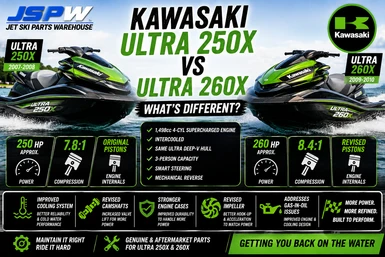
The Kawasaki Ultra 250X and Ultra 260X look extremely similar—and that's because underneath, they're closely related.
The Ultra 250X launched Kawasaki into the supercharged four-stroke performance era, while the Ultra 260X arrived for 2009 as its updated replacement.
But Kawasaki didn't simply add another 10 horsepower and change the decals.
The 260X received several important engine and jet pump revisions designed to improve performance, durability and the way the engine operated.
If you're buying one, repairing one or trying to work out whether Ultra 250X and 260X parts interchange, here's what you need to know.
Ultra 250X vs Ultra 260X At A Glance
| Specification | Ultra 250X | Ultra 260X |
|---|---|---|
| Model Years | 2007–2008 | 2009–2010* |
| Engine | 1498cc Inline 4 | 1498cc Inline 4 |
| Induction | Supercharged & Intercooled | Supercharged & Intercooled |
| Power | Approx. 250 HP | Approx. 260 HP |
| Compression Ratio | 7.8:1 | 8.4:1 |
| Fuel System | Electronic Fuel Injection | Electronic Fuel Injection |
| Hull | Ultra Deep-V | Ultra Deep-V |
| Fuel Capacity | Approx. 78L | Approx. 78L |
| Riders | 3 | 3 |
*Model availability can vary by market.
The basic recipe remained the same: a large, stable Ultra hull powered by Kawasaki's supercharged 1498cc four-cylinder engine.
The important differences are inside.
1. The Ultra 260X Makes More Power
The obvious difference is in the names.
Ultra 250X
Approximately 250 horsepower
Ultra 260X
Approximately 260 horsepower
An extra 10 horsepower doesn't sound enormous, but Kawasaki made several mechanical changes to achieve it.
The 260X wasn't simply an ECU tune.
2. Higher Compression Ratio
One of the biggest internal changes was compression ratio.
The Ultra 250X uses approximately:
7.8:1
The Ultra 260X increased this to:
8.4:1
Kawasaki achieved this partly through revised pistons.
The higher compression ratio contributed to the 260X's additional performance.
3. Revised Pistons
The 260X received updated pistons rather than simply carrying over the complete 250X configuration.
This is particularly important when ordering engine rebuild parts.
Don't assume that because both engines are 1498cc supercharged Kawasaki four-cylinders that every internal component is identical.
Always check:
-
Model
-
Year
-
Engine specification
-
OEM part number
before ordering pistons, rings or other internal components.
4. Revised Camshafts
Kawasaki also revised the camshaft configuration for the Ultra 260X.
The updated cams provided increased valve lift, helping the engine breathe more effectively and contributing to the increased output.
Again, this is why identifying whether you're working on a 250X or 260X matters when ordering engine components.
5. Stronger Engine Cases
The 260X also received strengthened engine cases to handle the revised engine configuration.
It's another example of Kawasaki doing more than simply increasing boost or changing ECU programming.
Several areas of the engine were revised together.
6. Cooling System Improvements
This is one of the most significant differences between the two models.
Kawasaki revised the cooling system on the 260X.
One reason was to allow the engine to maintain more appropriate operating temperatures, particularly when operating in colder water.
Some early Ultra 250X engines became known for fuel contamination of the engine oil, commonly referred to by owners as gas-in-oil or GIO.
The updated engine and cooling configuration used on the 260X was intended to improve this area.
What Is The Ultra 250X Gas-In-Oil Problem?
This is worth understanding if you're considering an older Ultra 250X.
Fuel can contaminate the engine oil when unburned fuel gets past the piston rings and enters the crankcase.
Possible signs include:
-
Engine oil level mysteriously increasing
-
Oil smelling strongly of petrol
-
Oil becoming unusually thin
-
Frequent oil contamination
Fuel-diluted engine oil doesn't provide the lubrication the engine was designed to operate with.
If you're looking at buying a used 250X, checking the engine oil should be high on your inspection list.
7. Revised Jet Pump Impeller
The additional engine performance required changes at the other end of the driveline.
Kawasaki revised the impeller for the Ultra 260X to better match the new engine's power delivery.
The revised setup helped improve acceleration and make better use of the additional power.
This is particularly important when ordering replacement impellers.
Don't choose an impeller based solely on the fact that the pump looks similar.
Always verify the correct application.
8. What Stayed The Same?
Despite the engine changes, these skis are much more alike than different.
Both use Kawasaki's large Ultra platform with its aggressive deep-V hull.
Both offer:
-
Excellent rough-water ability
-
Three-person seating
-
Large fuel capacity
-
Huge storage capacity
-
Kawasaki Smart Steering
-
Smart Learning Operation mode
-
Adjustable handlebars
-
Mechanical reverse
-
Variable trim
The basic riding character therefore remained very similar.
Which Is Faster?
The Ultra 260X has the advantage, but don't expect a dramatic difference.
The extra 10 horsepower and revised impeller provide improved acceleration and a small increase in outright performance.
In real-world riding, the condition of the ski can make a bigger difference than the badge.
A healthy stock 250X with:
-
Good compression
-
Healthy supercharger
-
Correct impeller
-
Good jet pump
-
Clean fuel system
may perform considerably better than a poorly maintained 260X.
What About The Supercharger?
Both models use a supercharged and intercooled version of Kawasaki's 1498cc four-cylinder engine.
The supercharger system should be carefully inspected on either model.
Check for:
-
Unusual supercharger noise
-
Bearing noise
-
Boost leaks
-
Damaged hoses
-
Loose clamps
-
Corrosion
-
Intercooler problems
Loss of boost can dramatically affect performance.
Are Ultra 250X And 260X Parts Interchangeable?
Some are.
Some definitely aren't.
Because the two skis share the same basic platform and engine family, there is considerable crossover.
However, differences exist in areas including:
-
Pistons
-
Engine internals
-
Camshafts
-
Cooling components
-
Jet pump/impeller components
-
Engine-related parts
There can also be year-to-year supersessions.
Never assume a 250X part fits a 260X just because it looks identical.
Cross-reference the OEM part numbers first.
What Should You Check When Buying A Used Ultra 250X?
If you're considering a 250X, pay particular attention to:
Engine Oil
Check the level and smell it for fuel contamination.
Compression
Test all four cylinders and compare the readings.
Supercharger
Listen for abnormal noise and check performance.
Jet Pump
Inspect the impeller, pump housing and bearings.
Cooling System
Look for corrosion, blocked passages and damaged hoses.
Service History
A well-maintained example is far more desirable than a neglected low-hour ski.
What Should You Check When Buying A Used Ultra 260X?
Many of the same checks apply:
-
Compression
-
Engine oil
-
Supercharger
-
Intercooler
-
Jet pump
-
Impeller
-
Cooling system
-
Electrical system
-
Corrosion
-
Service history
The 260X improved several areas of the earlier design, but these machines are now old enough that condition and maintenance history are extremely important.
Ultra 250X vs Ultra 260X: Which Is Better?
If both skis were sitting beside each other in comparable condition, we'd choose the Ultra 260X.
You get:
-
Slightly more power
-
Revised pistons
-
Higher compression
-
Revised camshafts
-
Updated cooling system
-
Revised impeller
-
Improvements addressing some issues seen with the earlier 250X
But that doesn't automatically make every 260X a better purchase.
A meticulously maintained 250X can be a much better buy than a neglected 260X.
With PWCs of this age, condition beats specification.
Need Kawasaki Ultra Parts?
Jet Ski Parts Warehouse stocks a huge range of Kawasaki Ultra parts for the 250X, 260X and other Kawasaki models, including:
-
Pistons and rings
-
Engine rebuild components
-
Gasket kits
-
Camshafts
-
Supercharger components
-
Intercoolers
-
Cooling system parts
-
Jet pumps
-
Impellers
-
Pump housings
-
Bearings and seals
-
Starter motors
-
Fuel system components
-
Genuine OEM parts
-
Premium aftermarket parts
-
Quality used OEM components
If you're trying to determine whether a 250X and 260X component is interchangeable, contact JSPW with your model, year and OEM part number.
We'll help cross-reference the correct part before you order.
Final Thoughts
The Ultra 250X and Ultra 260X share the same DNA, but the 260X represents more than a 10-horsepower upgrade.
Kawasaki revised the pistons, compression ratio, camshafts, engine cases, cooling system and impeller when developing the 260X.
For owners repairing either model, those differences also mean you shouldn't assume every component interchanges.
Identify the exact model, check the OEM part number and order parts specifically for your ski.
Get that right, maintain the supercharger and jet pump properly, and both the Ultra 250X and 260X remain seriously capable rough-water performance machines.