21st Oct 2026
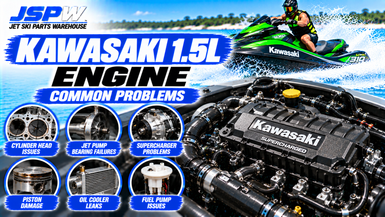
Kawasaki 1.5L Engine Common Problems: What Owners Should Watch For
Kawasaki's 1.5-litre four-stroke engine family powers a range of Jet Ski models, including versions of the Ultra series. These engines deliver strong performance, but like any marine engine, their reliability depends on maintenance, operating conditions and the specific model and engine configuration.
If you're buying a used Kawasaki Ultra or troubleshooting an existing machine, it's important to understand the warning signs of cooling-system faults, lubrication problems, fuel and ignition issues, and supercharger-related concerns on applicable models.
Important: Not every Kawasaki 1.5L engine is supercharged. The naturally aspirated and supercharged versions have different components and potential failure points, so confirm the exact model year and engine version before diagnosing a problem.
1. Cylinder Head Problems on Early Ultra 250X and 260X Models

One of the most significant historical reliability concerns involves the early supercharged Kawasaki Ultra 250X and Ultra 260X engines.
Reports from owners and specialist technicians describe cracked cylinder heads and serious engine damage on some of these models. The problem was not universal, but it is an important consideration when buying an older supercharged Ultra.
Symptoms to watch for
-
Unexplained coolant or water-related problems.
-
Engine overheating or unusual operating temperatures.
-
Poor running or reduced compression.
-
Difficult starting or loss of power.
-
Evidence of previous cylinder-head repairs.
These symptoms can have several causes, so they do not prove a cracked head. A compression test, leak-down test and appropriate inspection are needed to confirm internal damage.
Buying advice: If you're considering an Ultra 250X or 260X, ask whether the cylinder head has been inspected or replaced and whether there is documentation of any related repairs.
2. Jet Pump Bearing and Thrust-Bearing Failure

The jet pump is critical to propulsion, and bearing problems on some early supercharged Ultra models are a major issue to investigate.
Specialist reports describe failures of the pump bearings on early Ultra 250X and 260X models. In certain failure scenarios, a seized pump bearing can damage the impeller, pump housing or driveshaft. The resulting mechanical loads may also damage engine components.
Warning signs
-
Grinding or rumbling from the pump area.
-
Abnormal vibration.
-
Impeller or driveshaft damage.
-
Reduced thrust or unexpected changes in propulsion.
-
Excessive bearing play found during inspection.
How to reduce the risk
Have the jet pump inspected for bearing condition, shaft movement and signs of overheating or water intrusion. Ask about any documented pump upgrades or rebuilds.
Do not assume the pump is healthy just because the engine runs well. A mechanical failure in the driveline can turn into a much more expensive repair.
The appropriate inspection and service interval depends on the exact pump and model. Use the relevant Kawasaki service information rather than treating one interval as universal.
3. Supercharger Belt, Tensioner and Bearing Problems

The supercharged 1.5L Kawasaki engines add a supercharger and its associated drive components to the engine package.
These components require more attention than the intake system on a naturally aspirated engine. Wear, incorrect belt tension, bearing deterioration or other mechanical faults can affect boost and engine performance.
Symptoms to watch for
-
Unusual supercharger whine, rattling or grinding.
-
Reduced acceleration or top speed.
-
Inconsistent performance under load.
-
Visible belt deterioration or damage.
-
Metallic debris or other signs of internal wear.
A change in engine performance does not automatically mean the supercharger has failed. Fuel delivery, intercooler efficiency, ignition and jet-pump condition can all influence acceleration and top speed.
Have the supercharger and drive system inspected according to the model-specific maintenance schedule. If you hear a new grinding noise or suspect internal damage, avoid continuing to ride hard until the cause is identified.
4. Piston and Ring-Land Damage on Some Ultra 300 and 310 Engines

Some Ultra 300 and 310 owners have reported piston damage, including damage around the piston ring lands. Specialist repair sources identify piston condition as an area worth checking when diagnosing certain supercharged Kawasaki engines.
The ring lands are the sections of the piston that support and separate the piston rings. Damage in this area can affect compression and allow combustion gases to escape past the rings.
Factors such as detonation, excessive heat, poor fuel quality, engine condition and demanding operation can contribute to piston damage.
Symptoms to watch for
-
Reduced engine power.
-
Difficult starting.
-
Uneven running or misfires.
-
Low compression in one or more cylinders.
-
Excessive oil consumption or unusual exhaust smoke.
-
Metallic noises in severe cases.
These symptoms are not exclusive to piston damage. Ignition faults, fuel-delivery problems and valve-sealing issues can produce similar results.
What to check
If an Ultra 300 or 310 has lost power or developed a persistent misfire, start with diagnostic fault codes and basic engine checks. If indicated, carry out compression and leak-down testing and inspect the engine internally.
Do not assume every 310 has a piston defect. Individual engine condition and documented repair history are more useful than generalisations about an entire model range.
5. Oil Cooler Leaks and Lubrication Problems

Oil-system problems deserve attention because inadequate lubrication can damage bearings and other internal engine components.
Owner discussions about older Kawasaki Ultra models include reports of cracked oil coolers. A leak or internal failure can be expensive if it leads to oil loss or contamination.
Symptoms to watch for
-
Oil-pressure warnings.
-
Visible oil leaks around the cooler or related hoses.
-
Unexplained oil-level changes.
-
Oil contamination or an unusual oil appearance.
-
Abnormal engine noises.
Check the oil level and condition using the correct service procedure. If an oil-pressure warning appears or you suspect a significant leak, stop the engine and investigate before restarting.
If the oil looks milky, do not assume the cause is automatically the oil cooler. Water contamination can have several sources, and the system needs to be diagnosed properly.
6. Fuel-Pump and Fuel-Delivery Problems

Fuel-delivery problems can cause hesitation, loss of power, stalling or difficult starting.
A January 2026 report from The Watercraft Journal discusses fuel-pickup and fuel-delivery concerns on some Kawasaki Ultra 310 and STX 160 models. The reported symptoms include inconsistent fuel supply under certain conditions, particularly as fuel levels drop. These reports warrant investigation but should not be taken as proof that every example has the same fault.
Symptoms to watch for
-
Long cranking before the engine starts.
-
Hesitation under sustained acceleration.
-
Power loss when the tank is low.
-
Stalling or inconsistent running.
-
Performance that changes as fuel level falls.
What to do
Start by checking fuel quality, fault codes, electrical connections and the service history. If necessary, a technician can test fuel pressure and inspect the pump, pickup and filters.
For a used craft, ask whether the fuel pump or related components have been replaced or modified, and request supporting documentation.
7. Cooling-System Blockages and Overheating

Kawasaki personal watercraft use raw water in designated cooling circuits. Debris, salt deposits, restricted passages or a damaged hose can reduce cooling flow.
Overheating should never be dismissed as a minor issue. Continued operation at excessive temperature can damage the cylinder head, pistons and other engine components.
Symptoms to watch for
-
An overheating warning.
-
Reduced engine performance.
-
Little or no expected cooling-water discharge.
-
Steam or unusual smells.
-
Engine problems following a blockage or restricted water supply.
How to prevent overheating
-
Check the intake and pump area for weeds, sand or debris.
-
Inspect accessible cooling hoses and connections.
-
Flush the craft according to Kawasaki's instructions.
-
Investigate repeated temperature warnings rather than repeatedly resetting them.
A cooling fault may be caused by a simple restriction, but it can also indicate a more serious mechanical issue. Diagnose the source before returning the craft to service.
8. Electrical Connections and Harness Problems
Electrical faults can produce intermittent starting issues, warning lights, unexpected shutdowns or reduced engine performance.
Kawasaki Australia published a safety recall concerning certain 2022–2023 model-year JT1500 Ultra 310 and related variants. The recall described main-harness splices that might not be sufficiently sealed, potentially allowing water intrusion and corrosion that could cause an engine stall. Owners should check the official recall information against their craft's identification details.
Symptoms to watch for
-
Intermittent starting problems.
-
Unexpected engine shutdown.
-
Warning lights or diagnostic codes.
-
Corroded electrical connections.
-
Electrical faults that appear after exposure to water.
Inspect visible connections and wiring for corrosion or damage. Do not assume every electrical issue is caused by the recalled harness; use the exact model and identification details to establish whether a recall applies.
Naturally Aspirated vs Supercharged Kawasaki 1.5L Engines
Not all Kawasaki 1.5L engines share the same risks.
|
Engine family |
Key considerations |
|---|---|
|
STX-15F and Ultra LX naturally aspirated models |
Cooling, lubrication, ignition, fuel delivery and jet-pump condition |
|
Ultra 250X and 260X |
Historical cylinder-head and pump-bearing concerns; supercharger condition |
|
Ultra 300X and 300LX |
Supercharger maintenance, cooling, pump condition and general engine health |
|
Ultra 310 series |
Supercharger, fuel delivery, piston condition on affected engines, cooling and electrical checks |
These are general inspection priorities rather than a prediction that a particular model will fail. Model-year changes, previous repairs and maintenance history matter.
What to Check Before Buying a Used Kawasaki 1.5L Jet Ski
Use this checklist when inspecting a used STX-15F, Ultra LX, Ultra 250X, Ultra 260X, Ultra 300 or Ultra 310.
Used Kawasaki inspection checklist
0 / 10
A water test and a professional inspection are especially valuable on older supercharged models. A good-looking hull and low engine hours do not guarantee that the engine or jet pump is in good condition.
Final Thoughts
The Kawasaki 1.5L engine family can deliver strong performance, but buyers should pay particular attention to the historical cylinder-head and pump-bearing concerns on early Ultra 250X and 260X models, supercharger condition, piston condition on affected engines, lubrication, fuel delivery and cooling.
The most important point is to identify the exact engine and diagnose the actual fault. A loss of power could be caused by the engine, fuel system, supercharger or jet pump, and each requires a different repair.
Before replacing components, confirm the correct part numbers and fitment for the specific Kawasaki model and year.
Jet Ski Parts Warehouse supplies parts for a range of personal watercraft, helping owners and mechanics source components for maintenance and repairs.