
14th Oct 2026
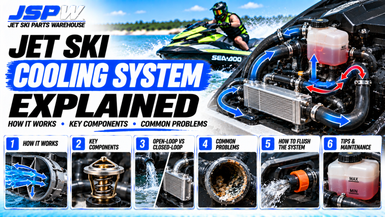
Jet Ski Cooling System Explained
A jet ski cooling system is responsible for keeping the engine, exhaust and other components within their correct operating temperature range. If the cooling system becomes blocked, leaks, or stops circulating water properly, the engine can overheat and suffer serious damage.
Unlike most cars, many jet skis use water from the surrounding environment to help cool the engine. However, the exact system varies between Sea-Doo, Yamaha and Kawasaki models, and some engines use additional closed-loop cooling circuits.
This guide explains how the system works, which components to check, and how to recognise common cooling problems.
1. The Two Main Types Of Jet Ski Cooling Systems
Most personal watercraft use one of two main cooling arrangements.

Open-loop cooling
Water is drawn from the surrounding water and routed through cooling passages in the engine and/or exhaust before being discharged.
Common on many older two-stroke jet skis, this system depends on unobstructed water passages and correctly sized fittings.

Closed-loop cooling
Engine coolant circulates through internal engine passages and transfers heat to the surrounding water through a heat exchanger, commonly the ride plate.
This keeps raw water out of the engine's internal coolant circuit. Many modern Sea-Doo Rotax four-stroke engines use this arrangement.
Some models combine closed-loop engine cooling with an open-loop circuit for exhaust or other components. Always identify the specific cooling arrangement before diagnosing a problem.
2. How An Open-Loop Cooling System Works

The typical water flow is:
Jet pump water supply
Cooling hoses and fittings
Engine cooling passages
Exhaust cooling and water injection
Water discharged overboard
The exact routing varies by engine. Some older Sea-Doo two-stroke systems use pressure generated in the jet pump rather than a separate engine-driven cooling-water pump.
Why the hoses and fittings matter
Cooling hoses and fittings aren't always interchangeable. Some systems use calibrated fittings to control water flow.
A fitting with the wrong internal diameter, a blocked passage or an incorrectly routed hose can cause inadequate cooling and potentially severe engine damage.
3. How A Closed-Loop Cooling System Works

A typical closed-loop system includes:
-
Coolant reservoir: provides a supply of engine coolant.
-
Water pump: circulates coolant through the engine.
-
Engine water jackets: absorb heat from the cylinders and cylinder head.
-
Thermostat: regulates coolant flow according to temperature.
-
Ride plate heat exchanger: transfers heat from the coolant to the surrounding water.
-
Coolant hoses and bleed lines: circulate coolant and help remove trapped air.
-
Temperature sensor: monitors engine temperature and may trigger an overheating warning.
On many Sea-Doo Rotax four-stroke engines, coolant flows through the engine and oil cooler before passing through the ride plate heat exchanger. The thermostat controls the flow path as the engine warms up.
Important: The engine coolant and surrounding water are separate circuits in this design. A coolant leak and a blocked raw-water passage therefore require different diagnostic approaches.
4. The Main Cooling System Components

Cooling hoses
Carry water or coolant between components. Look for cracks, kinks, swelling, loose clamps and internal blockages.

Thermostat
On systems fitted with one, regulates coolant flow to maintain the intended operating temperature. A stuck thermostat can cause overheating or incorrect temperature control.

Ride plate heat exchanger
On applicable closed-loop models, transfers heat from engine coolant into the surrounding water. Damage, corrosion or poor coolant circulation can affect heat transfer.

Exhaust cooling components
Exhaust manifolds, pipes and mufflers can require their own water-cooling flow. A restriction here can cause exhaust overheating even if the engine itself seems to run normally.

Coolant reservoir
Fitted to many closed-loop systems. Check the coolant level when the engine is cold and look for leaks, contamination or repeated unexplained coolant loss.
5. Common Jet Ski Cooling System Problems
Engine overheating
Possible causes include:
-
Blocked cooling passages
-
Damaged or kinked hoses
-
Insufficient coolant
-
Faulty thermostat
-
Poor coolant circulation
-
Heat exchanger problems
-
Incorrect hose routing
The first step is to identify whether the engine is genuinely overheating and determine which cooling circuit is affected.
No water coming from the expected outlet
On many open-loop systems, water should discharge from designated outlets while the engine is running under the conditions specified by the manufacturer.
No flow can indicate a blocked fitting, hose or cooling passage. However, outlet arrangements vary by model, so don't assume every visible outlet should produce the same flow.
Older Sea-Doo service manuals specifically recommend checking elbows, straight fittings and hoses for blockages when investigating a lack of cooling-water flow.
Coolant disappearing
On a closed-loop system, repeated coolant loss can indicate:
-
Leaking hoses or connections
-
A leaking reservoir or cap
-
A damaged heat exchanger
-
An internal engine leak
Never remove a hot coolant reservoir cap. Allow the engine to cool completely before checking the level.
Exhaust overheating
A restricted exhaust-water circuit can overheat exhaust components even when the engine's symptoms aren't immediately obvious.
Inspect the relevant hoses, fittings and water-injection points according to the service manual.
Salt or sand blockage
Salt deposits, sand and other debris can restrict cooling passages. Yamaha recommends flushing its WaveRunner cooling passages with fresh water after use to help prevent clogging from salt, sand and dirt.
6. How To Flush A Jet Ski Cooling System
Flushing removes salt and other deposits from cooling passages on models that require it.
The procedure is model-specific. Some jet skis use a garden-hose flushing connection, while others require different arrangements.
For applicable Yamaha WaveRunner models, Yamaha's published procedure includes positioning the craft correctly, connecting the specified hose adapter, starting the engine before turning on the water, flushing at idle, then turning off the water before stopping the engine.
Follow these general precautions:
-
Read the owner's manual before connecting a hose.
-
Use the correct flushing connection.
-
Follow the specified engine-start and water-supply sequence.
-
Keep the engine at the prescribed speed and for the prescribed duration.
-
Monitor the craft throughout the procedure.
-
Shut down and disconnect everything in the specified order.
Never assume that every jet ski can be flushed using the same sequence. Incorrect water flow or running the engine without the required cooling arrangements can cause damage.
Sea-Doo specifically warns against running its watercraft out of the water except for the limited flushing procedure described by the manufacturer.
7. Jet Ski Cooling System Maintenance Checklist
Use this as a starting point, alongside the maintenance schedule for the particular model.
Maintenance checklist
0 of 8
8. When Should You Stop Riding?
Stop the engine and investigate if you experience:
-
An overheating alarm
-
A sudden temperature rise
-
Steam or an unusual burning smell
-
Coolant leaking
-
An unexpected loss of cooling-water flow
-
A new abnormal engine or exhaust noise
Don't keep running the ski to see whether the problem clears. Allow it to cool and follow the manufacturer's troubleshooting procedure.
Final Thoughts
A jet ski cooling system is more than a collection of hoses. It is a carefully designed arrangement of water passages, fittings, heat exchangers, pumps and temperature-control components.
The most important distinction is whether your ski uses open-loop cooling, closed-loop cooling, or a combination of both. That determines how the system should be inspected, flushed and repaired.
For JSPW customers, cooling-system repairs may involve replacement hoses, clamps, fittings, thermostats, coolant and other model-specific components. Always confirm compatibility by make, model, year and engine before ordering parts.