
2nd Sep 2026
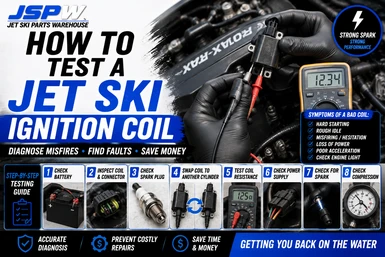
How To Test A Jet Ski Ignition Coil: A Step-By-Step Guide
If your jet ski is misfiring, difficult to start, running rough or suddenly losing power, a faulty ignition coil could be the cause.
Modern Sea-Doo, Yamaha and Kawasaki jet skis rely on ignition coils to deliver the high voltage required by the spark plugs. When a coil begins to fail, the engine may continue running—but one cylinder may not be producing its share of the power.
Before buying a replacement coil, there are several checks you can perform to help determine whether the coil is actually the problem.
What Does An Ignition Coil Do?
The battery and electrical system operate at relatively low voltage.
A spark plug requires a much higher voltage to create a spark strong enough to ignite the air/fuel mixture inside the cylinder.
The ignition coil converts the electrical supply into the high-voltage pulse required by the spark plug.
Many modern jet skis use coil-on-plug ignition, meaning each cylinder has its own individual ignition coil positioned directly above the spark plug.
If one coil fails, the remaining cylinders may continue operating.
That's why a three- or four-cylinder jet ski can sometimes still run with a bad coil—just very poorly.
Common Symptoms Of A Bad Ignition Coil
A failing ignition coil can cause:
-
Difficult starting
-
Rough idle
-
Engine misfire
-
Hesitation
-
Loss of acceleration
-
Reduced top speed
-
Engine vibration
-
Increased fuel consumption
-
Fouled spark plug
-
Check-engine warning
-
One cylinder not firing
Some ignition coils fail completely.
Others become intermittent and only cause problems when the engine is hot or under heavy load.
Don't Assume The Coil Is Faulty
Several other problems can produce almost identical symptoms.
Before replacing an ignition coil, consider:
-
Fouled spark plug
-
Damaged spark plug
-
Loose electrical connector
-
Corroded wiring
-
Fuel injector problem
-
Low compression
-
ECU or sensor fault
Diagnosing the problem first can save you from replacing perfectly good parts.
What You'll Need
Depending on the test, you may need:
-
Digital multimeter
-
Spark plug socket
-
Basic hand tools
-
Known-good spark plug
-
Insulated tools
-
Workshop manual for your particular model
Always follow the manufacturer's diagnostic procedure where available.
Ignition systems can generate very high voltage, so don't touch coils, plug terminals or ignition components while the engine is operating.
Step 1: Check The Battery
Start with the basics.
A weak battery can create starting and electrical problems that may appear to be ignition related.
Check:
-
Battery charge
-
Battery terminals
-
Earth connections
-
Cable condition
Make sure the battery is healthy before diagnosing more complicated components.
Step 2: Check For Fault Codes
If your jet ski has an engine-management warning, retrieve any stored fault codes where possible.
A diagnostic code may point toward:
-
Ignition circuit
-
Specific cylinder
-
Wiring problem
-
Sensor issue
However, remember that a fault code doesn't automatically mean the coil itself has failed.
The wiring and connector should also be inspected.
Step 3: Inspect The Ignition Coil
Remove the seat and access the ignition coils.
Inspect each coil for:
-
Cracks
-
Heat damage
-
Corrosion
-
Water intrusion
-
Damaged rubber boot
-
Burn marks
-
Loose electrical connector
Pay particular attention to the electrical terminals.
Saltwater corrosion can create poor connections that mimic a failed coil.
Step 4: Inspect The Spark Plug
Remove the spark plug from the suspected cylinder.
Compare it with the others.
Look for:
Wet With Fuel
The cylinder may be receiving fuel but not producing adequate spark.
Dry Black Carbon
The plug may be fouled.
Oily
There may be an engine-related problem rather than an ignition-coil problem.
One Plug Looks Completely Different
This can help identify which cylinder has the fault.
If the spark plugs are old, replacing the complete set before condemning a coil can sometimes be worthwhile.
Step 5: Swap The Coil With Another Cylinder
On engines using identical individual ignition coils, this is often one of the most useful diagnostic tests.
For example, imagine you suspect Cylinder 2 has a faulty coil.
-
Remove the coil from Cylinder 2.
-
Swap it with the coil from Cylinder 1.
-
Reassemble everything correctly.
-
Run the engine or repeat the appropriate diagnostic test.
-
See whether the misfire moves to Cylinder 1.
If The Problem Moves
The ignition coil is a strong suspect.
If The Problem Stays On Cylinder 2
The problem may instead involve:
-
Spark plug
-
Fuel injector
-
Wiring
-
Compression
-
ECU output
-
Another engine fault
This simple swap test can prevent unnecessary parts replacement.
Only use this method where the coils are confirmed to be interchangeable.
Step 6: Check The Electrical Connector
Disconnect the coil connector and inspect it carefully.
Look for:
-
Bent pins
-
Green corrosion
-
Water
-
Loose terminals
-
Broken wires
-
Damaged insulation
A coil can't work correctly if it isn't receiving the correct electrical supply and control signal.
Repair wiring problems before replacing the coil.
Step 7: Test Coil Resistance
Some ignition coils can be checked using a digital multimeter.
Depending on the coil design, the workshop manual may provide resistance specifications for the primary and/or secondary winding.
Set the multimeter to the appropriate resistance range and measure across the specified terminals.
Then compare your result with the manufacturer's specification.
Important
Not every modern coil-on-plug unit can be conclusively diagnosed with a simple resistance test.
A coil can sometimes pass a static resistance test but fail when:
-
Hot
-
Under load
-
Operating at high RPM
Treat resistance testing as one part of the diagnosis rather than absolute proof that the coil is healthy.
Step 8: Check The Coil's Power Supply
With the correct wiring information for your model, verify that the coil is receiving the required supply voltage.
If there's no power at the connector, the problem isn't necessarily the coil.
Investigate:
-
Fuse
-
Wiring
-
Connector
-
Relay where applicable
-
ECU-related circuit
Never probe connectors randomly without knowing the circuit you're testing.
Step 9: Check For Spark Safely
A spark test can help determine whether the cylinder is receiving ignition.
However, use a proper spark tester and follow the manufacturer's procedure.
Avoid holding a spark plug against the engine with your bare hands or touching ignition components while cranking.
The ignition system produces high voltage.
If one cylinder has no spark while the others do, investigate the coil, spark plug, wiring and ECU control circuit for that cylinder.
Step 10: Test The Coil When The Problem Occurs
Intermittent ignition-coil problems can be difficult to diagnose.
A coil may work perfectly when the engine is cold but begin failing once it heats up.
If your ski:
-
Runs well when cold
-
Starts misfiring after several minutes
-
Loses power when hot
-
Runs normally again after cooling
heat-related ignition-coil failure is worth investigating.
Perform your comparison tests while the fault is actually present whenever possible.
Ignition Coil Or Fuel Injector?
A failed coil and failed injector can both cause one cylinder to stop contributing properly.
One useful clue is the spark plug.
Plug Wet With Fuel
Fuel appears to be entering the cylinder, making an ignition problem more likely.
Plug Completely Dry
Fuel delivery may deserve closer investigation.
This isn't a definitive test, but it can help point diagnosis in the right direction.
Ignition Coil Or Low Compression?
If swapping coils doesn't move the misfire, check compression.
Low compression can be caused by:
-
Worn piston rings
-
Damaged piston
-
Cylinder wear
-
Valve problems on four-strokes
-
Head gasket problems
An ignition coil can't fix a mechanical engine problem.
If one cylinder has significantly lower compression than the others, investigate the engine before buying additional electrical parts.
What Causes Ignition Coils To Fail?
Ignition coils can deteriorate because of:
-
Age
-
Heat
-
Vibration
-
Water intrusion
-
Saltwater corrosion
-
Damaged connectors
-
Electrical faults
-
Worn or incorrect spark plugs
Keeping the engine compartment dry and electrical connections protected can help extend component life.
Should You Replace All Ignition Coils At Once?
Not necessarily.
Unlike spark plugs, ignition coils don't generally need to be replaced as a complete set simply because one has failed.
If the remaining coils test correctly and are in good condition, replacing only the faulty unit is usually reasonable.
However, inspect all of them while you have access.
Don't Forget The Spark Plugs
A damaged or badly worn spark plug can place additional demand on the ignition system.
Whenever diagnosing ignition problems:
-
Inspect the plugs.
-
Check the correct plug specification.
-
Check the gap where applicable.
-
Replace worn plugs.
Spark plugs are inexpensive compared with ignition coils and engine components.
Quick Ignition Coil Diagnostic Checklist
If you suspect a faulty coil:
-
Check the battery.
-
Read any fault codes.
-
Inspect the coil and connector.
-
Inspect the spark plug.
-
Swap coils between cylinders where appropriate.
-
Check whether the misfire follows the coil.
-
Check coil resistance if specifications are available.
-
Verify electrical supply.
-
Check spark safely.
-
Check compression if the problem remains on the same cylinder.
Following this order can save a lot of unnecessary parts replacement.
Need A Replacement Ignition Coil?
Jet Ski Parts Warehouse stocks ignition and electrical components for a wide range of Sea-Doo, Yamaha and Kawasaki jet skis, including:
-
Ignition coils
-
Spark plugs
-
Plug leads
-
Starter motors
-
Starter solenoids
-
Voltage regulators
-
Sensors
-
Electrical components
-
Genuine OEM parts
-
Premium aftermarket replacements
-
Quality used OEM components
If you're unsure which ignition coil fits your jet ski, contact JSPW with your make, model, year and OEM part number where available, and we'll help identify the correct replacement.
Final Thoughts
A faulty ignition coil can make a perfectly healthy jet ski engine feel like it has a serious mechanical problem.
The key is to diagnose rather than guess.
Inspect the spark plug and electrical connections first, then use a coil swap test where appropriate to see whether the problem moves from one cylinder to another.
If it doesn't, look deeper into the fuel system, wiring and engine compression.
A few minutes of systematic testing can save you from replacing unnecessary parts—and get your Sea-Doo, Yamaha or Kawasaki back on the water sooner.