
23rd Sep 2026
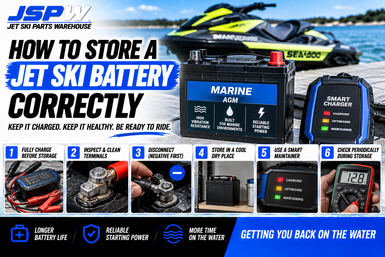
How To Store A Jet Ski Battery Correctly: Prevent A Flat Battery During Storage
Your jet ski might be parked up for winter, waiting for summer or simply sitting unused for a few months—but your battery is still slowly losing charge.
Incorrect battery storage is one of the most common reasons jet ski owners discover a dead battery when they're finally ready to get back on the water.
The good news is that storing a jet ski battery correctly is simple.
Whether you own a Sea-Doo, Yamaha or Kawasaki, here's how to protect your battery during long periods without use.
Why Jet Ski Batteries Go Flat During Storage
A battery doesn't need to be connected to a running jet ski to lose charge.
All batteries gradually self-discharge over time.
When installed in the ski, there may also be a small electrical draw from systems such as:
-
ECU and electronics
-
Security systems
-
Displays
-
Accessories
-
Other electrical circuits
Leave the ski sitting long enough and a healthy battery can eventually become deeply discharged.
Why Leaving A Battery Flat Is Bad
Allowing a lead-acid or AGM battery to remain discharged for extended periods can contribute to sulfation.
This reduces the battery's ability to accept and hold a charge.
The result can be a battery that:
-
Charges slowly
-
Doesn't reach full capacity
-
Goes flat quickly
-
Produces insufficient starting power
-
Requires premature replacement
Keeping the battery properly charged during storage can significantly extend its useful life.
Step 1: Fully Charge The Battery Before Storage
Don't put a partially discharged battery into storage.
Before parking the ski for an extended period, charge the battery using a charger suitable for its chemistry and capacity.
Common PWC battery types include:
-
AGM
-
Conventional lead-acid
-
Lithium on some aftermarket installations
These battery types can have different charging requirements.
Always confirm which battery you have before connecting a charger.
Step 2: Inspect The Battery
Before storing it, check its physical condition.
Look for:
-
Cracked case
-
Swelling
-
Leaking
-
Corroded terminals
-
Loose terminals
-
Damaged cables
A swollen, leaking or physically damaged battery shouldn't simply be charged and returned to service.
Step 3: Clean The Terminals
Corrosion around battery terminals can create electrical resistance and starting problems.
Clean the terminals and connections where required.
Make sure they're:
-
Clean
-
Dry
-
Free from corrosion
A suitable terminal protectant can then help reduce future corrosion.
Step 4: Disconnect The Battery
If the ski will be stored for an extended period, disconnecting the battery can prevent parasitic electrical loads from slowly draining it.
When disconnecting:
Remove:
Negative (-) FIRST
then
Positive (+) SECOND
This reduces the risk of accidentally shorting the positive terminal against grounded components.
Step 5: Should You Remove The Battery From The Jet Ski?
For longer storage periods, removing the battery can be a good option.
It allows you to:
-
Store it somewhere suitable
-
Easily connect a maintenance charger
-
Inspect it periodically
-
Keep it away from excessive moisture
If you leave the battery installed, make sure the compartment remains dry and the battery is correctly secured.
Step 6: Store The Battery Somewhere Cool And Dry
Heat accelerates battery self-discharge and ageing.
Choose a storage location that's:
-
Dry
-
Well ventilated
-
Protected from extreme heat
-
Protected from direct sunlight
-
Away from sparks and flames
Avoid storing batteries next to fuel containers or other ignition hazards.
Can You Store A Battery On A Concrete Floor?
Yes.
The old advice that batteries shouldn't be stored on concrete comes from much older battery designs.
Modern battery cases aren't normally discharged simply because they're sitting on concrete.
The important factors are:
-
Temperature
-
State of charge
-
Cleanliness
-
Moisture
-
Battery condition
A clean, dry and stable location is what matters.
Step 7: Use A Smart Maintenance Charger
For many conventional lead-acid and AGM jet ski batteries, a quality smart charger or battery maintainer is one of the easiest ways to keep the battery healthy during storage.
A proper maintainer can:
-
Monitor battery voltage.
-
Charge when required.
-
Reduce or stop charging once appropriate.
-
Maintain the battery without continuously forcing a high charging current.
This is very different from leaving an old-style basic charger connected indefinitely.
Battery Charger vs Battery Maintainer
They're not necessarily the same thing.
Battery Charger
Primarily designed to recharge a discharged battery.
Smart Maintainer
Designed to keep an already charged battery at an appropriate state of charge during storage.
Many modern smart chargers can perform both functions automatically.
For long-term storage, look for a charger specifically designed for maintenance charging.
Don't Use A Charger That's Too Powerful
Jet ski batteries are much smaller than most car batteries.
Using an inappropriate high-output charger can potentially:
-
Overheat the battery
-
Damage the battery
-
Reduce battery life
Use a charger suitable for the battery's:
-
Voltage
-
Chemistry
-
Capacity
Follow both the battery and charger manufacturers' instructions.
What About Lithium Jet Ski Batteries?
Lithium batteries need different treatment.
If your ski has an aftermarket lithium battery, don't automatically connect the same charger you use for an AGM battery.
Depending on the battery, you may need:
-
Lithium-compatible charger
-
Specific storage state of charge
-
Different long-term maintenance procedure
Follow the battery manufacturer's instructions.
Some lithium batteries shouldn't be left permanently connected to a conventional lead-acid maintainer.
Step 8: Check The Battery Periodically
If you're not leaving the battery on a compatible smart maintainer, check it periodically during storage.
Don't wait six months and hope for the best.
Monitor:
-
Voltage
-
State of charge
-
Physical condition
-
Terminal corrosion
Recharge when required using the correct charger.
What Voltage Should A Stored Battery Have?
For a conventional 12V lead-acid or AGM battery, a fully charged resting voltage will typically be around 12.6–12.8 volts, depending on battery type and conditions.
However, voltage alone doesn't tell you everything about battery health.
A battery may show acceptable resting voltage but collapse under starter load.
If starting performance is questionable after storage, a proper load test can provide more useful information.
Step 9: Don't Let The Battery Freeze
A fully charged lead-acid battery is significantly more resistant to freezing than a deeply discharged battery.
This matters particularly in colder climates.
Keeping the battery properly charged during winter storage helps protect it from both sulfation and freezing-related damage.
Step 10: Reinstall The Battery Correctly
When it's time to get the ski ready again, inspect the battery before installation.
Check:
-
Case condition
-
Terminal condition
-
Charge level
-
Cable condition
Then secure the battery properly.
A PWC battery experiences considerable vibration and movement, so the retaining strap or bracket is important.
Correct Battery Connection Order
Installation is the reverse of removal.
Connect:
Positive (+) FIRST
then
Negative (-) SECOND
Make sure the terminals are secure without overtightening small terminal bolts.
Step 11: Test Before Going To The Boat Ramp
Don't wait until launch day to discover the battery is dead.
Before your first ride:
-
Check battery voltage.
-
Turn the electrical system on.
-
Check the display.
-
Start the engine according to the manufacturer's procedure.
-
Listen for strong cranking.
If the starter turns noticeably slower than normal, investigate before heading to the ramp.
Should You Start Your Jet Ski Every Few Weeks During Storage?
Starting the engine briefly isn't a substitute for correct battery maintenance.
Short engine runs may not recharge the battery sufficiently and can introduce other problems if the engine isn't operated according to the correct out-of-water procedure.
If your goal is simply to maintain the battery, use an appropriate charger or maintainer instead.
Can You Leave A Jet Ski Battery Connected All Winter?
You can physically leave it installed, but whether it should remain electrically connected depends on the ski, storage period and charging arrangement.
For extended storage, common options include:
Disconnect The Battery
This helps eliminate parasitic draw.
Remove And Maintain It
Useful when the ski is stored somewhere where power isn't available.
Leave It Installed With An Appropriate Maintainer
Convenient where the battery and charger manufacturers permit this.
The important thing is preventing prolonged deep discharge.
Common Battery Storage Mistakes
Avoid these:
Leaving The Battery Flat
One of the quickest ways to shorten its life.
Using The Wrong Charger
Especially important with AGM and lithium batteries.
Using A Large Automotive Charger Without Checking Suitability
PWC batteries are relatively small.
Ignoring Corroded Terminals
Corrosion can cause voltage drop even with a healthy battery.
Leaving Accessories Connected
Aftermarket accessories may continue drawing power.
Forgetting About The Battery For Months
Check it periodically.
How Long Should A Jet Ski Battery Last?
Battery lifespan varies considerably depending on:
-
Battery quality
-
Battery type
-
Climate
-
Riding frequency
-
Charging system
-
Storage conditions
-
Maintenance
-
How often it's deeply discharged
A battery that's correctly maintained during storage will generally have a much better chance of providing reliable service than one repeatedly allowed to go completely flat.
What If The Battery Won't Hold A Charge After Storage?
If you've charged the battery but it quickly goes flat again, it may have suffered permanent deterioration.
Possible causes include:
-
Sulfation
-
Internal battery damage
-
Age
-
Repeated deep discharge
Before replacing it, also make sure the ski doesn't have:
-
Parasitic electrical draw
-
Charging-system fault
-
Loose connections
-
Corroded terminals
Otherwise, the replacement battery may end up with exactly the same problem.
Quick Jet Ski Battery Storage Checklist
Before long-term storage:
-
Identify battery type
-
Fully charge battery
-
Inspect battery condition
-
Clean terminals
-
Disconnect negative first
-
Remove battery if appropriate
-
Store somewhere cool and dry
-
Use a compatible smart maintainer
-
Check periodically
-
Don't allow prolonged deep discharge
Before riding again:
-
Fully charge battery
-
Inspect terminals
-
Secure battery correctly
-
Connect positive first
-
Test starting performance
-
Check charging system if necessary
Need Jet Ski Battery & Electrical Parts?
Jet Ski Parts Warehouse stocks starting and electrical components for a wide range of Sea-Doo, Yamaha and Kawasaki jet skis, including:
-
Jet ski batteries
-
Battery cables
-
Starter motors
-
Starter solenoids
-
Voltage regulators
-
Electrical components
-
Genuine OEM parts
-
Premium aftermarket replacements
-
Quality used OEM components
If you're unsure which battery or electrical component fits your ski, contact JSPW with your make, model and year, and we'll help identify the correct replacement.
Final Thoughts
Storing a jet ski battery correctly comes down to three things:
Keep it charged. Keep it clean. Don't leave it deeply discharged for months.
For most AGM and conventional lead-acid batteries, a compatible smart maintainer is an excellent option during extended storage.
If you remove the battery, store it somewhere cool and dry and check its charge periodically.
And remember the connection order:
Removal: Negative first → Positive second
Installation: Positive first → Negative second
Spend a few minutes looking after the battery during storage and you'll have a much better chance of hearing the engine crank strongly when it's finally time to get back on the water.
SEO Title: How To Store A Jet Ski Battery Correctly During Winter & Long-Term Storage
Meta Description: Learn how to store a jet ski battery correctly, prevent sulfation and flat batteries, choose the right maintainer and prepare your Sea-Doo, Yamaha or Kawasaki battery for long-term storage.