
30th Sep 2026
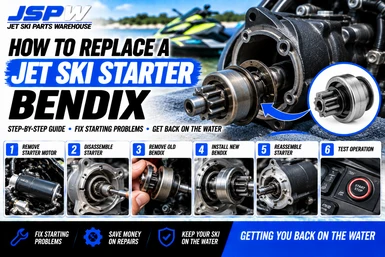
How To Replace A Jet Ski Starter Bendix: Step-By-Step Guide
If your jet ski starter motor spins but the engine doesn't crank, the starter Bendix could be the problem.
The Bendix—also called a starter drive on many models—is the mechanism that allows the starter motor to engage the engine's flywheel or starter gear. If it becomes worn, seized or damaged, the starter can spin without turning the engine.
The exact design varies considerably between Sea-Doo, Yamaha and Kawasaki models. On some skis, the Bendix is part of or mounted directly to the starter motor. On others, the starter drive is located separately in the engine, magneto or PTO assembly. (Scribd)
Here's how to diagnose the problem and what is generally involved in replacing it.
What Does A Jet Ski Starter Bendix Do?
When you press the start button, the starter motor needs to transfer its rotation to the engine.
The starter drive performs this job.
Depending on the design, it may:
-
Engage the starter gear
-
Drive the flywheel or ring gear
-
Prevent the engine from driving the starter once it starts
-
Transfer starter-motor torque to the engine
The Bendix incorporates a one-way clutch or similar mechanism on many applications.
Signs Of A Bad Starter Bendix
A faulty starter drive can produce some very recognisable symptoms.
1. Starter Spins But Engine Doesn't
You hear the starter motor spinning, but the engine isn't turning over.
This is one of the strongest indications of a starter-drive engagement problem.
2. Starter Makes A Grinding Noise
Grinding can indicate worn or damaged:
-
Starter-drive teeth
-
Starter gear
-
Ring gear/flywheel teeth
3. Starter Engages Intermittently
The ski may crank normally sometimes but simply spin without engaging at other times.
4. Starter Spins Very Quickly
If the starter suddenly sounds much faster than normal while the engine isn't cranking, the starter drive may not be engaging.
5. Starter Stays Engaged
A sticking or defective starter drive can sometimes remain engaged after the engine starts. This needs immediate attention because it can damage the starter and associated components. Sea-Doo service information lists a sticking or defective starter drive as a possible cause of the starter continuing to run. (Scribd)
Don't Blame The Bendix Immediately
Before removing anything, make sure the problem isn't elsewhere in the starting system.
Check:
-
Battery condition
-
Battery terminals
-
Ground cable
-
Starter cable
-
Starter solenoid
-
Starter motor
-
Starter drive
-
Starter gear
-
Ring gear
A weak battery can make a healthy starter system behave strangely.
Sea-Doo diagnostic procedures, for example, distinguish between slow cranking caused by battery/cable problems and a starter drive that fails to engage the ring gear. (Scribd)
How To Tell If The Starter Is Actually Turning The Engine
If possible, observe the engine while pressing the start button.
If the starter spins but:
The crankshaft isn't turning → investigate the starter drive.
If:
The crankshaft is turning but the engine won't start → the Bendix probably isn't your problem.
You should then investigate fuel, ignition, compression and other engine systems.
Before You Start
The biggest mistake when writing a universal Bendix replacement guide is assuming every jet ski has the same design.
They don't.
For example, some older Sea-Doo 4-TEC starters contain a removable Bendix directly inside the starter motor. Service information shows the Bendix being removed after taking off its retaining circlip. (Scribd)
Other Sea-Doo engines use a separate starter-drive assembly that requires access through the magneto/PTO area. (Scribd)
Always identify the exact make, model and year before ordering a replacement.
Tools You May Need
Depending on your jet ski, you may need:
-
Socket set
-
Spanners
-
Screwdrivers
-
Pliers
-
Circlip pliers
-
Torque wrench
-
Flywheel puller on applicable models
-
Engine support equipment
-
Replacement Bendix/starter drive
-
Replacement circlip where specified
-
Manufacturer-specified lubricant
Some models require considerably more disassembly than others.
Step 1: Disconnect The Battery
Before working on the starter system:
-
Remove the safety lanyard.
-
Switch the electrical system off.
-
Disconnect the battery.
On Sea-Doo service procedures, the battery ground/negative cable is disconnected first and reconnected last during starting-system work. (Scribd)
This is particularly important because the starter has a high-current electrical connection.
Step 2: Confirm The Starter Is The Problem
Before removing the Bendix, check the starter motor.
If the starter motor itself isn't turning, investigate:
-
Battery
-
Solenoid
-
Starter cables
-
Ground connection
-
Starter motor
If the starter spins normally but doesn't engage the engine, the starter drive becomes a much stronger suspect.
Step 3: Access The Starter Or Starter Drive
This is where the procedure becomes model-specific.
On Some Models
The starter can be removed and the Bendix accessed by disassembling the starter motor.
On Other Models
The starter drive is located separately and may require removal of:
-
Magneto cover
-
Flywheel/rotor
-
PTO housing
-
Starter gears
-
Other engine components
For example, Sea-Doo service procedures for some 4-TEC engines require removal of the magneto/PTO components to access the starter drive. (Scribd)
Don't start removing major engine components until you've confirmed the procedure for your model.
Step 4: Remove The Retaining Hardware
Where the Bendix is mounted directly to the starter, there may be a retaining circlip.
Remove the circlip carefully.
Don't lose it.
Some applications should receive a new circlip during reassembly.
Sea-Doo service information specifically calls for removal of the Bendix retaining circlip and starter Bendix on applicable starter designs. (Scribd)
Step 5: Remove The Old Bendix
Slide or pull the Bendix from the starter shaft according to the model-specific procedure.
Inspect the shaft while you're there.
Look for:
-
Corrosion
-
Scoring
-
Excessive wear
-
Damaged splines
-
Dirt
-
Lack of lubrication where lubrication is specified
Don't force a component off if it appears mechanically trapped.
Step 6: Inspect The Old Bendix
A damaged Bendix can usually be identified by examining its gear and one-way clutch.
Look for:
Damaged Teeth
Rounded, chipped or broken teeth indicate wear.
One-Way Clutch Slipping
The starter drive should transfer torque in the intended direction while freewheeling in the other.
Seized Mechanism
A drive that doesn't move correctly can cause engagement problems.
Excessive Wear
Compare the old component with the new one.
Step 7: Inspect The Starter Gear And Ring Gear
Don't replace the Bendix and ignore the gears it engages with.
A damaged starter drive can damage the mating gear.
Inspect for:
-
Rounded teeth
-
Missing teeth
-
Chipped teeth
-
Cracks
-
Abnormal wear
Sea-Doo service information specifically instructs technicians to inspect starter-drive gears and the ring gear for wear and damage. (Scribd)
If the ring gear is badly damaged, replacing only the Bendix won't solve the problem.
Step 8: Inspect The Starter Shaft
Check the shaft where the Bendix operates.
It should be:
-
Clean
-
Straight
-
Free from excessive corrosion
-
Free from heavy scoring
If the shaft is badly damaged, the new Bendix may not operate correctly.
Step 9: Install The New Bendix
Compare the replacement with the original before installation.
Check:
-
Overall dimensions
-
Number of teeth
-
Shaft diameter
-
Splines
-
One-way clutch direction
-
Part number
Install the new Bendix in the correct orientation.
Don't assume that a physically similar Bendix is compatible.
Step 10: Install The Retaining Clip
If the design uses a circlip, reinstall it correctly.
On applications where the service procedure specifies a new circlip, replace it rather than reusing the old one.
Make sure the clip is completely seated in its groove.
A partially seated retaining clip can allow the starter drive to move out of position.
Step 11: Lubricate Where Specified
This is another area where you shouldn't use a universal rule.
Some starter-drive components require specific lubrication.
Others have different lubrication requirements.
For example, Sea-Doo service information specifies lubrication of certain starter-drive shafts, gears, splines and bearings with particular products depending on the component. (Scribd)
Use the lubricant and quantity specified for your exact model.
Don't pack the starter mechanism with grease simply because it contains moving parts.
Step 12: Reassemble The Starter
If the Bendix is inside the starter motor, reassemble the starter carefully.
Make sure:
-
Brushes are correctly positioned
-
Armature is correctly installed
-
Washers are in the correct locations
-
End covers are correctly aligned
-
Through bolts are secure
Some Sea-Doo starter procedures use alignment marks on the starter housing during disassembly to assist correct reassembly. (Scribd)
Step 13: Reinstall The Starter
Before installing the starter:
-
Clean the mounting surfaces.
-
Check the O-ring where applicable.
-
Lubricate the O-ring if specified.
-
Make sure the starter seats correctly.
Some Sea-Doo procedures specifically warn that the starter and engine mating surfaces must be clean and correctly aligned during installation. (Scribd)
Step 14: Reconnect The Starter Cable
Reconnect the main starter power cable.
Make sure:
-
Terminal is clean
-
Connection is tight
-
Protective boot is correctly positioned
Keep the positive cable away from anything that could cause a short circuit.
Step 15: Reconnect The Battery
Reconnect the battery:
Positive (+) first
Negative (-) last
Check that the terminals are tight and secure.
Step 16: Test The Starter
Before fully reassembling everything, confirm that the starter now engages the engine correctly.
The starter should:
-
Engage smoothly
-
Turn the engine
-
Crank consistently
-
Disengage correctly
Listen carefully for:
-
Grinding
-
Clicking
-
Starter free-spinning
-
Unusual mechanical noise
If the starter still spins without turning the engine, stop and investigate rather than repeatedly pressing the start button.
What If The New Bendix Still Doesn't Work?
If the new starter drive doesn't solve the problem, check:
-
Starter motor
-
Battery
-
Solenoid
-
Starter gear
-
Ring gear
-
Starter-drive bearing
-
Wiring
-
Engine mechanical condition
On some Sea-Doo models, the starter-drive assembly has separate bearings that can wear and require inspection or replacement. (Scribd)
Why Do Jet Ski Bendix Gears Fail?
Common causes include:
-
Normal wear
-
Damaged starter gear
-
Damaged ring gear
-
Weak battery
-
Poor electrical connections
-
Corrosion
-
Incorrect lubrication
-
Seized starter drive
-
Repeated starting attempts
A weak battery is particularly important because poor starter engagement can place additional stress on the starting system.
Don't Keep Pressing The Start Button
If the starter is grinding or repeatedly failing to engage, stop.
Repeated attempts can damage:
-
Starter gear
-
Bendix
-
Ring gear
-
Starter motor
-
Other starting-system components
A small starter-drive problem can become a much larger repair if you continue operating it.
When Should You Replace The Whole Starter?
If the Bendix is integrated into the starter and the starter motor also has:
-
Worn brushes
-
Damaged commutator
-
Bad bearings
-
Burnt windings
-
Excessive wear
a complete replacement starter may make more sense.
If the starter motor itself is healthy and the Bendix is separately replaceable, replacing only the failed drive can be a more targeted repair.
Quick Starter Bendix Diagnostic Checklist
If your jet ski won't crank:
Starter Doesn't Turn
Check:
-
Battery
-
Solenoid
-
Cables
-
Ground
-
Starter motor
Starter Spins But Engine Doesn't
Check:
-
Bendix/starter drive
-
Starter gear
-
Ring gear
Starter Grinds
Check:
-
Bendix
-
Starter gear
-
Ring gear
-
Alignment
Starter Works Sometimes
Check:
-
Battery
-
Electrical connections
-
Starter drive
-
Ring gear
-
Starter motor
Need A Jet Ski Starter Bendix?
Jet Ski Parts Warehouse stocks starting-system components for Sea-Doo, Yamaha and Kawasaki jet skis, including:
-
Starter Bendix units
-
Starter drives
-
Starter one-way assemblies
-
Starter motors
-
Starter gears
-
Starter solenoids
-
Starter rebuild components
-
Starter drive bearings
-
Genuine OEM parts
-
Premium aftermarket replacements
-
Quality used OEM components
If you're unsure which Bendix or starter drive fits your jet ski, send JSPW your make, model, year and OEM part number, and we can help identify the correct replacement.
Final Thoughts
A jet ski starter that spins without turning the engine doesn't automatically mean the entire starter motor is bad.
The Bendix/starter drive, starter gear and ring gear all need to be considered.
The exact replacement procedure varies significantly between models. Some Bendix units can be accessed by removing and disassembling the starter motor, while other starter-drive assemblies require much more extensive engine-side disassembly. (Scribd)
Before buying parts, diagnose the starting system and identify the exact model.
Then inspect the Bendix and the gears it engages.
Replacing the damaged component and correcting the underlying cause is the best way to get your jet ski cranking reliably again.
SEO Title: How To Replace A Jet Ski Starter Bendix: Step-By-Step Guide
Meta Description: Jet ski starter spins but won't crank the engine? Learn how to diagnose and replace a starter Bendix or starter drive, inspect the gears and identify common starting-system problems.