
7th Oct 2026
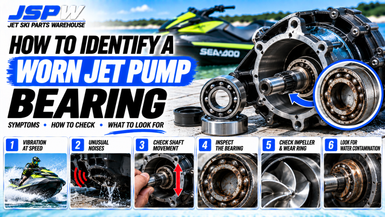
How To Identify A Worn Jet Pump Bearing
A worn jet pump bearing can cause some of the most confusing problems on a jet ski. The ski may still start and run, but you might notice vibration, unusual noise, excessive shaft movement, cavitation or reduced performance.
The good news is that there are several ways to check the jet pump before replacing expensive components.
The key is to distinguish a worn bearing from other common causes such as a damaged impeller, worn wear ring or bent driveshaft.
What Does The Jet Pump Bearing Do?
The jet pump bearing supports the impeller shaft and allows it to rotate smoothly at high speed.
The basic system is:
Engine → Driveshaft → Impeller Shaft → Impeller → Jet Pump
The bearing keeps the rotating shaft correctly positioned inside the pump housing.
If the bearing wears, the shaft can develop excessive radial movement. Sea-Doo service information specifically identifies excessive impeller-shaft radial play as potentially resulting from worn bearings, a worn shaft or damaged bearing surfaces in the pump housing. manualzz.com
7 Signs Of A Worn Jet Pump Bearing
1. Vibration At Speed
One of the most common symptoms is vibration that increases with RPM.
You may notice:
- Smooth operation at low speed
- Increasing vibration as RPM rises
- Strong vibration during acceleration
- Vibration coming from the rear of the ski
- Vibration accompanied by unusual jet-pump noise
However, vibration doesn't automatically mean the bearing is bad.
A damaged or unbalanced impeller can also produce significant vibration and can subsequently damage the wear ring, impeller shaft, seals and bearings. manualzz.com
2. Grinding, Rumbling Or Whining Noise
A healthy jet pump should rotate smoothly.
A worn bearing may produce:
- Grinding
- Rumbling
- Whining
- Growling
- Metallic noises
Noise that changes directly with engine RPM is particularly worth investigating.
If you hear a new mechanical noise from the rear of the ski, don't assume it's simply normal jet-pump noise.
3. Excessive Impeller Shaft Movement
This is one of the best ways to confirm a bearing problem.
With the appropriate components removed, the impeller shaft can be checked for radial play.
Sea-Doo service procedures use a dial indicator to measure shaft movement. On one Sea-Doo jet-pump design, the specified maximum radial play is 0.05 mm (0.002 in). manualzz.com
Important: Don't apply that number universally to every Sea-Doo, Yamaha or Kawasaki.
Different jet pumps have different designs and specifications. Always use the service specification for the exact model.
4. You Can Feel Play In The Shaft
On some pumps, excessive movement can be felt during inspection.
With the impeller removed and the shaft accessible, carefully check for abnormal movement.
A worn bearing may allow the shaft to move:
Up ↕ Down
or
Side ↔ Side
There should not be obvious excessive looseness.
But again, play doesn't automatically prove the bearing is the problem.
The shaft itself or the bearing surface inside the pump housing can also be worn. Sea-Doo's service information specifically notes that excessive radial play can come from the bearing, shaft or housing bearing surfaces. manualzz.com
5. The Impeller Doesn't Spin Smoothly
Another useful check is rotational feel.
With the pump correctly disassembled for inspection, rotate the impeller shaft by hand.
It should rotate smoothly.
A rough, notchy or gritty feeling can indicate bearing damage.
Sea-Doo service procedures specifically instruct technicians to install the bearings and impeller shaft and ensure the shaft rotates smoothly. manualzz.com
Don't confuse normal drivetrain resistance with bearing roughness.
The exact feel depends on the design of the pump and what components are still installed.
6. Corrosion, Pitting Or Scoring
Once the pump is apart, visually inspect the bearing.
Look for:
- Rust
- Corrosion
- Pitting
- Scoring
- Damaged rollers
- Discolouration
- Flaking
- Contamination
- Abnormal wear patterns
Sea-Doo service information specifically calls for inspection of bearing surfaces for corrosion, scoring, pitting, chipping and other evidence of wear. manualzz.com
A bearing that has been exposed to water and corrosion should not simply be cleaned and reused without proper assessment.
7. Water Contamination
Water is particularly bad news for jet pump bearings.
The pump operates in a wet environment and relies on seals to protect internal components.
A damaged seal can allow water into the bearing area, eventually causing corrosion and premature bearing failure.
Look for:
- Rust
- Water contamination
- Damaged seals
- Corrosion around the shaft
- Pitting on bearing surfaces
If a bearing has obvious corrosion, replacement is generally the sensible option rather than trying to extend its life.
How To Check A Jet Pump Bearing
Here's a practical diagnostic process.
Step 1 — Inspect The Intake
Before pulling the pump apart, check for:
- Weed
- Rope
- Fishing line
- Plastic
- Sand
- Rocks
- Other debris
A blocked intake can cause performance problems that may initially feel like a mechanical fault.
Step 2 — Inspect The Impeller
Look carefully at every blade.
Check for:
- Bent blades
- Chipped blades
- Cracks
- Missing material
- Cavitation damage
- Uneven blade edges
An unbalanced impeller can create vibration and damage the surrounding pump components. manualzz.com
Step 3 — Check The Wear Ring
Inspect the area between the impeller and wear ring.
Look for:
- Deep scratches
- Grooves
- Uneven wear
- Excessive clearance
- Damage around the circumference
Don't immediately blame the bearing if the impeller-to-wear-ring clearance is excessive.
Step 4 — Check Shaft Movement
If the pump design allows it, measure the impeller shaft with a dial indicator.
This is far more accurate than simply moving the shaft by hand.
The service procedure measures the difference between the highest and lowest dial-indicator readings as the shaft is moved up and down. manualzz.com
Step 5 — Inspect The Bearing
Once the pump is disassembled, inspect the bearing itself.
Look for:
Good bearing:
- Clean
- Smooth
- No obvious corrosion
- No pitting
- No damaged rollers
- Smooth rotation
Bad bearing:
- Rough rotation
- Rust/corrosion
- Pitting
- Scoring
- Damaged rollers
- Excessive play
Bearing vs Wear Ring vs Impeller
These three problems can produce surprisingly similar symptoms.
| Symptom | Bearing | Wear Ring | Impeller |
|---|---|---|---|
| Vibration | ✅ | Possible | ✅ |
| Grinding noise | ✅ | Possible | Possible |
| Cavitation | Possible | ✅ | ✅ |
| Reduced acceleration | Possible | ✅ | ✅ |
| Reduced top speed | Possible | ✅ | ✅ |
| Shaft play | ✅ | ❌ | ❌ |
| Damaged blades | ❌ | ❌ | ✅ |
| Excessive impeller clearance | ❌ | ✅ | Possible |
| Rough shaft rotation | ✅ | ❌ | Possible |
This is why replacing the bearing without inspecting the entire pump can be an expensive mistake.
What Happens If You Keep Riding?
A badly worn bearing shouldn't be ignored.
As bearing wear increases, shaft movement can increase as well.
That can potentially lead to:
- Impeller contact
- Shaft damage
- Seal damage
- Pump housing damage
- Increased vibration
- Further bearing failure
- More expensive repairs
Sea-Doo service documentation specifically notes that an unbalanced/damaged impeller can damage the wear ring, impeller shaft, shaft seal and bearings. manualzz.com
Should You Replace Both Jet Pump Bearings?
On designs using multiple bearings, it is often sensible to replace the related bearings together when the pump is already apart.
For example, older Sea-Doo service information recommends replacing both bearings when one requires replacement and also suggests renewing the thrust bearing and thrust washer when applicable. SeaDoo ManyManuals
However, follow the service procedure for your specific jet pump rather than assuming every model uses the same bearing arrangement.
Don't Forget The Impeller Shaft
A common mistake is replacing the bearing while ignoring the shaft.
If the shaft has:
- Scoring
- Pitting
- Corrosion
- Excessive wear
- Damaged bearing surfaces
a new bearing may not fix the problem.
Sea-Doo service information specifically instructs technicians to inspect the impeller shaft's bearing contact surfaces and measure the shaft where required. manualzz.com
If the shaft is worn, the bearing and shaft may both need replacement.
What About The Jet Pump Housing?
The pump housing itself can also become worn.
If the bearing has been spinning in the housing or the bearing seat has been damaged, simply installing a new bearing may not restore the correct fit.
This is another reason why excessive shaft play needs to be properly diagnosed.
The excessive play may originate from:
Bearing → Shaft → Housing
rather than the bearing alone. manualzz.com
A Quick Jet Pump Bearing Diagnosis
If you're trying to diagnose a customer's jet ski, this is a useful starting sequence:
Vibration?
⬇
Inspect impeller
⬇
Inspect wear ring
⬇
Check for debris
⬇
Check shaft movement
⬇
Measure radial play
⬇
Inspect bearing
⬇
Inspect shaft and housing
This prevents you from automatically replacing the most expensive component first.
When Should You Replace The Bearing?
Replace or repair the bearing system when inspection reveals:
- Excessive radial play
- Rough rotation
- Grinding
- Corrosion
- Pitting
- Damaged rollers
- Excessive bearing clearance
- Bearing damage confirmed by measurement
If the bearing is damaged, also inspect the impeller shaft, seal and housing before installing the new bearing.
Final Thoughts
A worn jet pump bearing can be difficult to diagnose because vibration, noise and poor performance can also come from the impeller, wear ring, driveshaft or other components.
The most reliable approach is to work through the pump systematically.
Inspect → Measure → Identify the worn component → Replace the damaged parts
Don't rely solely on how much movement you can feel by hand. Where the service manual provides a radial-play specification, a dial indicator is the proper way to measure it. manualzz.com
For JSPW, the components commonly involved in this repair include jet pump bearings, impeller shafts, seals, wear rings and impellers.