4th Jul 2026
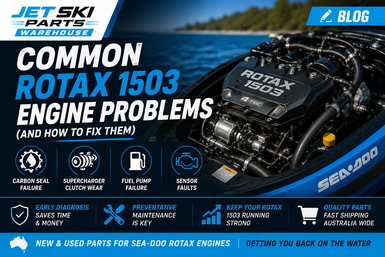
Common Rotax 1503 Engine Problems (And How to Fix Them)
The Rotax 1503 engine is one of the most successful personal watercraft engines ever built. Found in a huge range of Sea-Doo models including the GTI, GTX, RXT, RXP, Wake and GTR, the 1494cc four-stroke engine has earned a reputation for reliability when properly maintained.
Like any engine, however, the Rotax 1503 has a handful of common issues that owners should be aware of. Catching these problems early can save thousands of dollars in repairs and prevent you from being stranded on the water.
1. Carbon Seal Failure
One of the best-known issues on Sea-Doo models using the Rotax 1503 is carbon seal wear.
Symptoms
- Water entering the engine bay
- Bilge pump constantly running
- Water around the driveshaft
- Excessive leaking while idling
Cause
The carbon seal creates a watertight seal around the driveshaft. Over time it wears naturally or can fail prematurely if debris enters the seal or the bellows loses tension.
Fix
Replace the complete carbon seal assembly including:
- Carbon ring
- Rubber bellows
- Stainless retaining clips
- Driveshaft if worn
2. Supercharger Clutch Wear (Supercharged Models)
Applies to:
- RXT
- RXP
- GTX Limited
- GTR
- Wake Pro
Symptoms
- Loss of acceleration
- Lower top speed
- Metallic debris in oil filter
- Supercharger slipping
Cause
Earlier ceramic clutch washers were prone to failure. Later models use improved metal washers but still require periodic inspection.
Fix
Rebuild the supercharger at the recommended service interval using updated components.
3. Ignition Coil Failure
Coils are common wear items on higher-hour engines.
Symptoms
- Misfire
- Rough idle
- Hard starting
- Check Engine light
- Engine running on two cylinders
Diagnosis
Swap ignition coils between cylinders and see if the fault follows the coil.
Fix
Replace the faulty ignition coil.
4. Fuel Injector Problems
Dirty fuel or long-term storage can clog injectors.
Symptoms
- Hard starting
- Poor idle
- Hesitation
- High fuel consumption
- Lean running
Fix
Clean or replace the injector and always use fresh fuel.
5. Fuel Pump Failure
Fuel pumps eventually wear out.
Symptoms
- Engine cranks but won't start
- Engine starts then stalls
- Power loss at high RPM
- Intermittent running
Diagnosis
Check fuel pressure using the manufacturer's specification.
Fix
Replace the fuel pump module if pressure is below specification.
6. Starter Solenoid Problems
Symptoms
- Clicking noise
- Starter won't engage
- No crank
Cause
Burnt contacts inside the solenoid.
Fix
Replace the starter solenoid.
7. Starter Motor Failure
Higher-hour engines eventually wear starter brushes.
Symptoms
- Slow cranking
- Clicking
- Starter spins weakly
Fix
Replace or rebuild the starter motor.
8. Overheating
Usually caused by cooling system restrictions rather than the engine itself.
Common causes
- Blocked intake grate
- Sand
- Weed
- Damaged wear ring
- Blocked cooling passages
Symptoms
- Overheat warning
- Reduced power
- Limp mode
9. Sensor Failures
Modern Rotax engines rely on multiple sensors.
Common failures include:
- MAP sensor
- Knock sensor
- Intake air temperature sensor
- Crank position sensor
- Coolant temperature sensor
Symptoms
- Check Engine light
- Limp mode
- Hard starting
- Poor performance
Always scan fault codes before replacing parts.
10. Exhaust Manifold Corrosion
Saltwater use accelerates corrosion.
Symptoms
- Water leaks
- Exhaust leaks
- Rust around manifold
- White residue
Regular flushing dramatically extends manifold life.
11. Oil Leaks
Common leak points include:
- PTO seal
- Valve cover gasket
- Oil filter housing
- Front crankshaft seal
Most are inexpensive to repair if caught early.
12. Low Compression
Usually only seen on neglected or very high-hour engines.
Causes
- Burnt valves
- Worn piston rings
- Damaged cylinder walls
- Overheating
A compression test quickly confirms engine condition.
Preventative Maintenance Tips
Most Rotax 1503 problems can be avoided with regular servicing.
We recommend:
- Change engine oil and filter every 50 hours or annually
- Replace spark plugs regularly
- Flush after every saltwater ride
- Replace fuel filters as scheduled
- Service the supercharger (where fitted)
- Inspect the carbon seal annually
- Keep the battery fully charged
- Use fresh premium fuel
Is the Rotax 1503 Reliable?
Absolutely.
The Rotax 1503 is widely regarded as one of the most reliable personal watercraft engines ever produced. Many engines exceed 500–1,000 hours with only routine maintenance, and well-maintained commercial or rental units have been known to surpass 2,000 hours.
Most major failures are the result of:
- Poor maintenance
- Saltwater corrosion
- Ignoring warning signs
- Lack of supercharger servicing
- Running the engine without adequate cooling
Need Rotax 1503 Parts?
Whether you're replacing a carbon seal, ignition coil, fuel pump, starter motor, supercharger components, gaskets, sensors or other service parts, Jet Ski Parts Warehouse stocks a huge range of new and used parts for Sea-Doo Rotax-powered watercraft.
Our team can also help identify the correct part for your exact model and year, so you can get back on the water with confidence.