
14th Oct 2026
Closed Loop vs Open Loop Cooling Systems: What's the Difference?
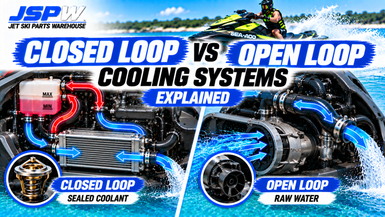
Jet ski engines generate a lot of heat, and their cooling systems are designed to keep temperatures under control while you're riding. However, not all personal watercraft cool their engines in the same way.
The two main types are open-loop cooling and closed-loop cooling. Understanding how they work can help you identify cooling problems, maintain your jet ski correctly and avoid expensive engine damage.
In this guide, we'll explain how each system works, the main differences between them, and what you need to know when maintaining a Sea-Doo, Yamaha WaveRunner or Kawasaki Jet Ski.
What Is Open-Loop Cooling?
An open-loop cooling system uses water from the surrounding lake, river or ocean to remove heat from the engine or other components.
Instead of continually circulating a dedicated engine coolant, the system draws in raw water, passes it through designated cooling passages and discharges it back out of the craft.
How an Open-Loop System Works
1. Water enters the cooling system
As the jet ski operates, water is supplied from the jet pump or a designated water pickup, depending on the model.
2. Water passes through cooling passages
The water flows through the components designed to be cooled by raw water, absorbing heat as it travels.
3. Heated water is discharged
After absorbing heat, the water exits through designated outlets. The exact route depends on the engine and cooling-system design.
4. Fresh water continues to flow
While the engine is running and the system is supplied with water, new water enters and heated water is discharged.
Advantages of Open-Loop Cooling
-
Simple design: The raw-water circuit does not require a sealed engine-coolant supply.
-
Fewer coolant-system components: There is no dedicated sealed engine-coolant circuit for the components cooled directly by raw water.
-
Straightforward operation: Water is drawn in, used to remove heat and discharged.
Disadvantages of Open-Loop Cooling
-
Corrosion risk: Saltwater can contribute to corrosion in components exposed to raw water.
-
Blockages: Sand, debris and mineral deposits can restrict water passages.
-
Flushing requirements: Freshwater flushing may be necessary after riding in saltwater, following the manufacturer's instructions.
-
Water-flow problems: A blocked hose, restricted passage or inadequate water supply can lead to overheating.
What Is Closed-Loop Cooling?
A closed-loop cooling system circulates a dedicated coolant through the engine rather than continually using raw water to cool the engine internally.
The coolant absorbs heat from the engine and carries it to a heat exchanger, where that heat transfers to the surrounding water. The coolant then returns to the engine and repeats the cycle.
Many Sea-Doo Rotax four-stroke engines use closed-loop cooling for the engine, although the exact arrangement varies by model.
How a Closed-Loop System Works
1. Coolant circulates through the engine
A coolant pump moves coolant through designated engine passages, where it absorbs heat.
2. The thermostat helps regulate temperature
As the engine warms up, the thermostat controls coolant flow according to the system's design.
3. Heat transfers through a heat exchanger
The hot coolant passes through a heat exchanger. On many Sea-Doo models, the ride plate helps transfer heat from the coolant to the surrounding water.
4. The coolant returns to the engine
After losing heat, the coolant returns through the circuit and continues circulating.
The important difference is that the coolant remains within a sealed circuit during normal operation. It does not mix with the surrounding water inside the heat exchanger.
Advantages of Closed-Loop Cooling
-
Reduced internal saltwater exposure: The engine's sealed coolant passages are protected from direct raw-water exposure.
-
Temperature control: The thermostat and coolant circuit help regulate engine operating temperature.
-
Reduced raw-water contamination: Sand and salt from the surrounding water are less likely to enter the sealed engine-coolant circuit.
Disadvantages of Closed-Loop Cooling
-
More components: The system relies on components such as a coolant pump, thermostat, hoses, heat exchanger and coolant reservoir where fitted.
-
Coolant maintenance: Coolant condition and level must be checked according to the manufacturer's service schedule.
-
Potential leaks: A damaged hose, seal or heat exchanger can cause coolant loss.
-
Overheating risks: Low coolant, restricted circulation, a faulty thermostat or a blocked heat exchanger can affect cooling performance.
Open Loop vs Closed Loop: The Main Differences
| Feature | Open-loop cooling | Closed-loop cooling |
|---|---|---|
| Fluid used to cool the engine | Raw water | Dedicated engine coolant |
| Fluid circulation | Raw water is discharged after use | Coolant recirculates |
| Heat removal | Water absorbs heat directly in designated passages | Heat transfers from coolant through a heat exchanger |
| Engine exposure to saltwater | Raw water contacts components in its circuit | Sealed engine-coolant passages avoid direct raw-water exposure |
| Maintenance focus | Water flow, flushing and blocked passages | Coolant condition, leaks, pump, thermostat and heat exchanger |
| Typical concern | Salt deposits or restricted raw-water flow | Coolant loss or poor circulation |
Neither design eliminates every cooling problem. Both depend on proper maintenance and adequate heat removal.
Do Closed-Loop Jet Skis Still Use Raw Water?
Yes. This is one of the most common misunderstandings about closed-loop cooling.
A closed-loop jet ski can still use raw water to cool other systems, including parts of the exhaust system or an intercooler, depending on the model.
That means a closed-loop craft may still need raw-water flushing after saltwater use. The sealed engine-coolant circuit itself is not normally flushed in the same way as a raw-water circuit.
Always check the owner's manual to determine which circuits require flushing and the correct procedure.
Common Cooling-System Problems
Open-Loop Problems
Blocked cooling passages: Salt deposits, sand or debris can restrict water flow.
Damaged or kinked hoses: A restriction can reduce the supply of cooling water.
Poor water supply: A problem with the pickup or water-supply route can reduce cooling performance.
Exhaust overheating: Some open-loop water circuits also cool exhaust components, so restrictions may damage more than the engine.
Closed-Loop Problems
Low coolant level: A falling coolant level can indicate a leak or another system fault.
Faulty thermostat: A thermostat that fails to operate correctly can interfere with temperature regulation.
Coolant-pump problems: Poor coolant circulation reduces heat transfer away from the engine.
Heat-exchanger restriction: A blocked or damaged heat exchanger can reduce the system's ability to release heat.
Air in the coolant circuit: Incorrect filling or servicing can affect circulation on systems that require proper bleeding.
How to Maintain Your Jet Ski Cooling System
Regardless of the design, a few maintenance habits can help prevent costly repairs.
-
Follow the manufacturer's flushing procedure after riding in saltwater.
-
Inspect accessible cooling hoses for cracks, leaks, kinks or loose connections.
-
Check coolant level and condition on closed-loop systems as directed by the service manual.
-
Investigate unexplained coolant loss rather than simply topping it up repeatedly.
-
Pay attention to overheating warnings, unusual engine temperatures or changes in water discharge.
-
Use the correct coolant and replacement parts for the specific make, model and year.
-
Never assume every jet ski can be run out of the water using the same procedure.
If your jet ski overheats, stop riding and follow the manufacturer's shutdown and troubleshooting instructions. Continuing to operate an overheating engine can cause serious damage.
Final Thoughts
The key difference is simple: open-loop cooling uses raw water directly in the designated cooling passages, while closed-loop cooling recirculates coolant and transfers heat to the surrounding water through a heat exchanger.
Knowing which system your jet ski uses helps you diagnose cooling problems, perform the right maintenance and choose the correct replacement parts.
Before replacing a thermostat, coolant pump, hose or other cooling component, confirm the exact fitment for your jet ski's make, model, year and engine.
Jet Ski Parts Warehouse stocks parts for a range of personal watercraft, helping owners and mechanics find the components they need to keep their machines running reliably.